
You can spend up to 180 days in a calendar year in India on a 1-year or 5-year e-Tourist visa; a 30-day e-Tourist visa permits a stay of 30 days from your first arrival. For travel in 2026, distinguish the visa’s validity from your permitted stay: a visa lasting several years does not authorise you to live in India for that entire period. These tourist limits do not replace the conditions on your individual visa or apply automatically to other e-visa categories.
In-short:
- India’s 1-year and 5-year e-Tourist visas cap total stays at 180 days per calendar year.
- The 30-day e-Tourist visa allows double entry within its validity period, not a fresh stay after every entry.
- For ‘how long can I stay in India on e-visa’, check visa category, arrival date and previous visits.
- Indian Visa Online is the government source for e-visa conditions; confirm your grant before booking your return.
Why this matters
Your departure city does not determine your visa allowance. Your passport nationality, visa category and grant conditions do. Flying from Melbourne, Sydney, Brisbane or Adelaide does not create a separate entitlement for Australian residents who hold another country’s passport.
This guide covers tourist visits in 2026. If you are travelling for treatment rather than a holiday or family visit, start with the India e-Medical visa guide for Australian patients instead.
How long can I stay in India on an e-visa from Australia?
For an Australian passport holder using an e-Tourist visa, the main distinction is between the short 30-day option and the longer-validity tourist visas. Count both the stay allowed for your visit and any total-stay limit across previous visits.
The Government of India’s Indian Visa Online e-Visa guidance states that total stays on the 1-year and 5-year e-Tourist visas must not exceed 180 days in a calendar year. Read that rule alongside the conditions printed on your issued permission, rather than treating the visa’s expiry date as your departure deadline.
| Tourist visa option | Validity basis | Stay and entry conditions | Best suited to | Main limitation |
|---|---|---|---|---|
| 30-day e-Tourist visa | 30 days from first arrival | Double entry within the validity period | A short holiday or family visit | A second entry does not restart the validity period |
| 1-year e-Tourist visa | 1 year from grant of the electronic travel authorisation | Multiple entry; maximum 180 days in India per calendar year | Repeat tourist visits within its validity | Validity is not permission for a year-long stay |
| 5-year e-Tourist visa | 5 years from grant of the electronic travel authorisation | Multiple entry; maximum 180 days in India per calendar year | Repeated tourist travel over several years | Longer validity does not increase the annual stay allowance |
Source: Government of India, Indian Visa Online, e-Visa information and frequently asked questions. For a 2026 departure, check the current government instructions and your issued authorisation before committing to travel dates.
Read the permission, not just the approval message
An approved application is not a substitute for reading its conditions. Save the electronic travel authorisation, check the passport details and identify the category, entry window and permitted stay.
After arrival, check your immigration endorsement too. If an entry condition or date is unclear, resolve it with Indian immigration rather than choosing the interpretation that gives you the longest trip.
30-day e-Tourist visa: 30 days from first arrival
The 30-day e-Tourist visa’s validity starts with your first arrival in India. It allows double entry during that validity period, which matters if you plan to leave India and return during the same trip.
Double entry does not mean two separate 30-day stays. A second arrival uses the remaining validity of the same visa; it does not create a new period simply because you crossed the border.
Keep the deadline for making your first entry separate from the validity that begins after arrival. The authorisation tells you when you must first enter, so do not calculate that deadline from your preferred flight date.
- Best for: a short tourist or family visit that fits entirely within the permitted period.
- Advantage: its validity begins with first arrival, rather than running as a year-long permission from grant.
- Limitation: changing your itinerary or returning after a side trip does not restart the clock.
If your plans already require a longer visit, choose the appropriate category before departure. Do not book a longer holiday on the assumption that a routine extension will be available after arrival.
1-year e-Tourist visa: maximum 180 days per calendar year
The 1-year e-Tourist visa provides multiple-entry validity for 1 year from the grant of the electronic travel authorisation. Its maximum total stay is 180 days in a calendar year, subject to the conditions of your permission.
That is useful for separate family visits, but it is not permission to remain in India for the entire year. Earlier visits count towards the annual total even when your next journey has a different purpose within the permitted tourist activities.
- Best for: travellers planning repeated tourist or family visits during the visa’s validity.
- Advantage: multiple entry supports separate journeys without treating each trip as an entirely new travel plan.
- Limitation: every visit consumes part of the same calendar-year allowance.
For 2026 planning, collect your entry and exit dates before choosing another return date. Looking only at the length of the next trip misses time you have already spent in India.
5-year e-Tourist visa: the same 180-day annual ceiling
The 5-year e-Tourist visa provides multiple-entry validity for 5 years from grant. It does not multiply your annual stay allowance: the maximum remains 180 days in a calendar year.
A longer-validity visa supports repeated visits, not continuous residence. That distinction matters if you expect to spend extended periods with relatives or are considering a permanent move.
- Best for: eligible travellers expecting repeated tourist visits over several years.
- Advantage: the longer validity accommodates travel across more than one annual holiday cycle.
- Limitation: the annual cap still applies, and the visa does not replace permission for work, study or residence.
Choose this option because it matches your pattern of tourist travel, not because the words ‘5 years’ appear to allow a longer individual holiday. Your actual itinerary must still comply with the applicable stay conditions.
Why your permitted stay varies
The answer changes with your immigration permission, not with the airline or Australian airport you choose. Check these factors together:
- Visa category: tourist, business and medical permissions have different purposes and conditions. Do not transfer a tourist allowance to another category.
- Passport nationality: living in Australia is not the same as holding an Australian passport. Read the rules for the passport used in your application.
- Validity start: the 30-day tourist option starts from first arrival; longer tourist validity runs from grant.
- Previous visits: time already spent in India affects the remaining calendar-year allowance on longer tourist visas.
- Entry conditions: double entry and multiple entry describe border crossings, not unlimited days in India.
- Individual permission: the conditions recorded on your authorisation and at immigration matter when setting your departure date.
For a trip during 2026, do not rely on a relative’s earlier visa or a screenshot of someone else’s approval. Their passport, visa category and travel history do not establish your entitlement.
How to check your departure deadline before booking
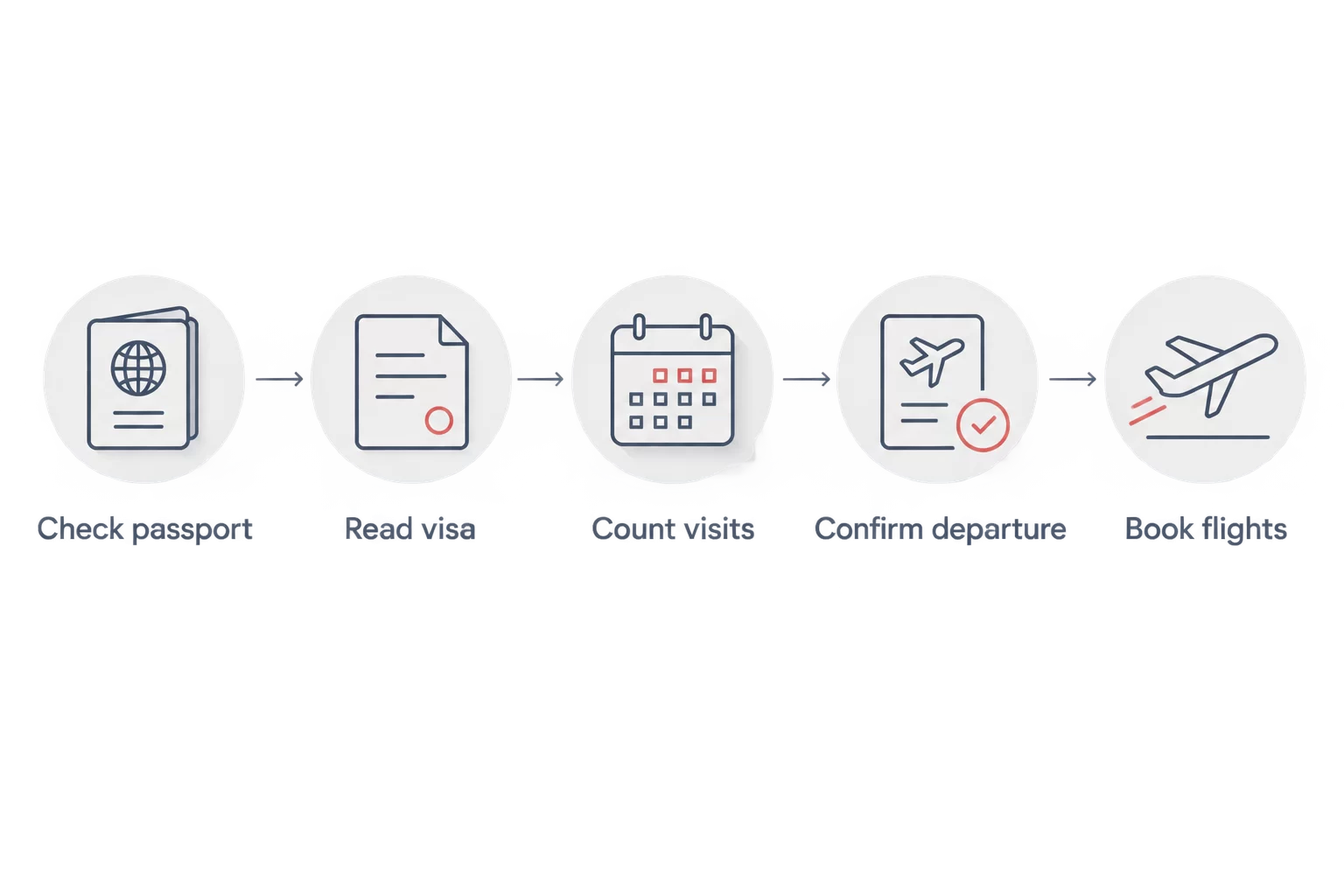
Use this sequence before confirming an international return flight. It keeps the visa calculation separate from the flight search, so an attractive itinerary does not become the basis for an immigration assumption.
- Check passport. Confirm which nationality and passport your visa application uses. Make sure the details on the authorisation match the document you will carry.
- Read visa. Identify the exact category, validity dates, entry allowance and any stay conditions. Separate the first-entry deadline from the period you can remain after arrival.
- Count visits. List previous arrivals and departures in the relevant calendar year. For a longer tourist visa, include those stays when assessing the remaining allowance.
- Confirm departure. Use the date your international flight leaves India, not the date it lands in Australia. Ask immigration to clarify an uncertain deadline before ticketing.
- Book flights. Choose an itinerary within the confirmed permission, allowing room to respond to disruption rather than deliberately targeting the last permitted day.
A domestic connection inside India is not your international departure. If you fly from an Indian regional city to Delhi or Mumbai before leaving the country, check the departure date of the international sector as well as the domestic booking.
Keep your previous travel records with your visa documents. Passport stamps, boarding passes and itinerary records help you reconstruct visits, but ask immigration to resolve discrepancies rather than estimating missing days.
Where flight-booking help fits
Mann Travel AU is best suited to Australia-to-India travellers seeking flight-booking help, not an immigration decision. The agency books international flights, including journeys between Australian cities and Indian destinations.
Bring your confirmed travel window when arranging flights. You can contact Mann Travel AU about the itinerary, but visa approval, stay limits and permission to remain belong to the Indian authorities. Booking assistance does not replace those decisions.
Does leaving India reset my e-visa stay allowance?
180 days per calendar year remains the total ceiling for the 1-year and 5-year tourist options, so leaving India does not erase days already used. On the short tourist option, re-entry also does not restart the 30-day validity that began with first arrival.
A side trip must fit the visa’s remaining validity, entry allowance and stay conditions. Do not plan a border crossing as a workaround for a stay limit.
Can I stay for a full year on a 1-year e-Tourist visa?
180 days per calendar year is not a full year of residence. The 1-year label describes the visa’s validity, while your stay remains subject to the annual ceiling and the conditions attached to your permission.
If your actual purpose is to relocate, work or study, establish the appropriate immigration route before booking. Tourist validity does not change the permitted purpose of travel.
Does a 30-day e-Tourist visa give me 30 days after each entry?
30 days runs from first arrival, not independently from each entry. Double entry lets you enter again within that visa’s validity; it does not grant a fresh stay period.
Check the final date before arranging an overseas side trip. Your return flight to India must satisfy the entry conditions, and your eventual departure must still fit the permission.
Frequently Asked Questions
How long can I stay in India on an e-visa with an Australian passport?
India’s 1-year and 5-year e-Tourist visas allow a maximum total stay of 180 days per calendar year, subject to your visa conditions. The 30-day e-Tourist visa is valid for 30 days from first arrival. Check the category and conditions on your issued permission.
Is a 5-year Indian e-visa permission to live in India?
No. A 5-year e-Tourist visa provides longer multiple-entry validity, not permission for continuous residence. The maximum total tourist stay remains 180 days per calendar year, subject to your permission.
Does my Indian e-visa start when it is approved or when I arrive?
The 30-day e-Tourist visa’s validity starts from first arrival, while the 1-year and 5-year tourist visas run from grant of the electronic travel authorisation. Check your authorisation separately for the deadline to make your first entry.
Can I extend my tourist e-visa after arriving in India?
Do not plan your trip around extending an e-Tourist visa; the standard permission is non-extendable. If exceptional circumstances affect your departure, contact the relevant Indian immigration authority before your permitted stay ends.
Does flying from Australia mean Australian visa rules apply to me?
No. Your passport nationality and visa category determine the applicable Indian entry conditions, not your departure airport. Australian residents travelling on another country’s passport must check the rules for that nationality.
Can I leave India and return on the same tourist e-visa?
Yes, within the entry allowance and validity of your visa. The 30-day tourist option permits double entry, while the 1-year and 5-year options permit multiple entry; returning does not erase previous stays.
Should I book my return flight for the last day of my permitted stay?
Choose a departure before your confirmed deadline rather than deliberately relying on the final permitted day. Flight disruption does not automatically extend immigration permission, so leave room to change your arrangements.
One last thing
The date you arrive in Australia is not the date you leave India. Overnight travel and connecting flights make those different dates easy to confuse when checking a booking confirmation.
Before finalising your 2026 itinerary, identify the international flight that actually departs India. Compare that local departure date with your confirmed immigration deadline, then check that any domestic connection reaches the international departure airport in time. A valid ticket and a valid visa serve different purposes; you need both to match the journey you intend to take.
Related guides
- How to check in online after booking your India flight
- How to add travel insurance to an existing flight booking
- Best time of year to visit India from Australia

