

A flight from Australia to India in 2026 has no fixed cost: your total depends on your travel dates, airports, cabin and ticket conditions. Compare the complete itinerary in Australian dollars, including the baggage, seats and connections you need—not just the fare shown in the first search result.
In-short:
- How much does a flight from Australia to India cost? Compare a dated, itinerary-specific total—not a route-wide estimate.
- Australia–India flight quotes need matching dates, baggage, cabin and currency before you compare them.
- A connecting flight is not automatically better value once transfers, baggage and overnight accommodation are considered.
- Mann Travel AU suits Australia–India travellers seeking an agency booking service rather than managing the booking alone.
Why this matters
A flight quote only answers your budget question when it covers the journey you actually need. A ticket to Delhi is not the same purchase as a journey that also gets you to your final destination elsewhere in India.
Currency matters, too. Before comparing an Australian-dollar quote with an Indian-rupee quote, read the guide to paying in AUD or INR when booking flights to India. Compare the final payable total in the same currency, including any applicable conversion or payment charges.
How much does a flight from Australia to India cost in 2026?
The cost is the current quote for your specific journey, not a fixed Australia–India rate. For a useful 2026 comparison, match the departure airport, arrival airport, dates, passenger details and cabin before looking at the total.
Start with this breakdown. Some items are included in a ticket; others require a separate purchase or depend on the itinerary.
| Cost component | What to check | Why it affects your budget |
|---|---|---|
| Airfare and taxes | The total for the selected flights and all passengers | A headline fare is not your whole-trip budget |
| Checked baggage | Allowance on every flight segment | An allowance on one segment does not establish the allowance for another |
| Seat selection | Whether your preferred seats are included | Optional seats can change the payable total |
| Connections | Ticket arrangement, airport changes and baggage collection | A transfer can involve additional travel arrangements |
| Overnight stops | Whether the itinerary requires accommodation | A flight comparison should account for necessary stopover expenses |
| Ticket conditions | Change, cancellation and no-show terms | A restrictive ticket creates different financial exposure |
| Payment | Billing currency and applicable charges | Compare the amount you will actually pay |
Keep a separate budget for expenses beyond the flight booking, such as airport transfers, travel insurance and any required travel documents. These belong in your trip budget even when they are purchased separately.
The right comparison is the total cost of a workable journey. A lower flight total does not settle the question if the itinerary leaves out something you need.
One-way tickets: compare the complete outbound journey
A one-way ticket is best for travellers who need an outbound journey without a booked return. Its advantage is straightforward: you are not choosing a return date as part of that purchase. Its limitation is equally clear: it does not cover your journey back to Australia.
Check any return or onward-travel requirements that apply to your circumstances before buying. Do not assume a ticket type is suitable solely because the booking system lets you select it.
If you expect to return, compare the one-way purchase with a return itinerary before committing. Do not assume a return ticket costs exactly twice a one-way ticket, or that buying the journeys separately produces a lower total.
Return tickets: check both directions
A return ticket is best for travellers who can specify their outward and homeward travel. It lets you assess the planned journey together, but the fare conditions still determine what happens if those plans change.
Review both directions separately. An acceptable outward itinerary does not make an awkward return connection acceptable, especially when you need to reach work or another commitment after arriving in Australia.
Check the baggage allowance, connection arrangements and fare conditions for all flight segments. Do not infer the return details from the outward journey.
Nonstop and connecting flights: compare time with total cost
Neither a nonstop flight nor a connecting itinerary wins automatically. Check which routing is offered for your particular airports and dates, then compare its total cost and practical demands.
The options below serve different needs. These are comparison criteria, not claims that a particular service operates on your travel dates.
| Itinerary type | Best for | Main advantage | Main limitation |
|---|---|---|---|
| Nonstop flight | Travellers prioritising fewer flight stages | No intermediate flight connection | You still need to compare the fare and ticket conditions |
| Connecting itinerary on one ticket | Travellers comfortable with a transfer | Multiple flight segments are arranged within one ticketed itinerary | Transfer requirements and disruption arrangements still need checking |
| Separately ticketed flights | Travellers prepared to manage independent bookings | Each journey can be selected separately | You must check baggage, check-in and missed-connection exposure between tickets |
A longer connection is not automatically a useful stopover. Check whether you can remain airside, whether baggage must be collected and whether changing airports is involved.
For separately ticketed flights, do not assume the next airline will accommodate you after an earlier delay. Read the conditions for each booking before treating the combination as a substitute for a through-ticket.
Why Australia–India flight costs vary
These factors explain why quotes differ. They do not establish a universally cheapest route, airline or booking date.
- Travel dates: Each selected departure and return date produces its own fare search. Compare alternatives only when you can genuinely travel on them.
- Departure and arrival airports: Melbourne–Mumbai and Sydney–Delhi are different journeys. Include the cost of reaching an alternative airport or continuing to your destination.
- Cabin and fare conditions: Compare the same cabin and check the rules attached to each fare. A cabin name alone does not describe cancellation or change terms.
- Routing: A nonstop journey, a connection and separately ticketed flights involve different travel arrangements. Assess those arrangements alongside the fare.
- Baggage and seating: Compare the allowance and seating arrangements you need, not a stripped-back ticket against one that already includes them.
- Passenger details: Enter the correct passenger count and ages. A quote for an individual traveller does not establish the total for a family booking.
For a 2026 trip, use the conditions attached to the itinerary you are considering. Advice from a previous journey is not a substitute for checking the current ticket.
How do you compare flight quotes fairly?
Use the same brief for every search or booking enquiry. Changing several details at once makes it difficult to tell whether you found a better fare or simply a different journey.
1. Set your dates
Write down your preferred outward and return dates, followed by any genuine alternatives. Include your required arrival date in India, not just the date you want to leave Australia.
A flight departing on your preferred day does not necessarily arrive on that day. Read the local arrival date before deciding that an itinerary fits a wedding, appointment or family event.
2. Match the journey
Keep the airports, passenger details and cabin consistent. If you compare another arrival airport, record the onward travel needed to reach your actual destination.
Compare 2 directions for a return trip: Australia to India and India to Australia. Assess the return connection with the same care as the outward connection.
3. Check inclusions
Confirm checked baggage, cabin baggage and any seating requirements. Read the allowance for each segment rather than relying on a general description of the airline.
For a family booking, distinguish a seating preference from a requirement. Confirm how the proposed booking addresses that requirement before paying.
4. Read conditions
Check changes, cancellations, no-shows and ticketing deadlines. Ask what charges and fare differences apply if your travel plans change.
Keep 3 written checks with the quote: baggage allowance, change conditions and connection arrangements. These details make the fare comparison useful after the search screen has closed.
5. Compare totals
Put every quote into 1 comparison currency: AUD. Record the quote time and compare the total payable for the same passengers and requirements.
A saved search is a reference, not proof that the same fare remains bookable. Recheck the final itinerary and payment total before authorising the purchase.
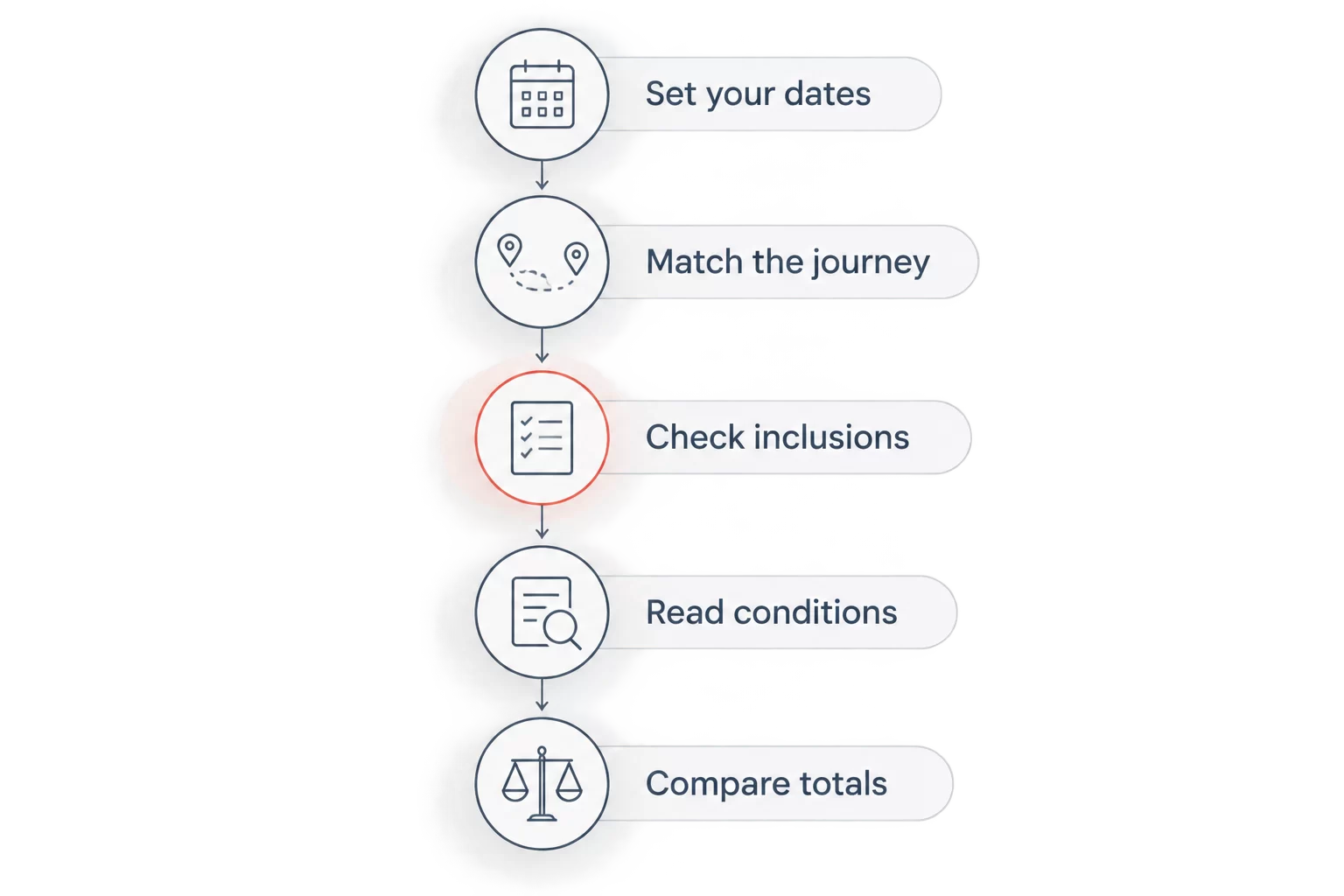
Once those checks are complete, the decision becomes clearer: choose between journeys that actually meet your needs, rather than sorting unlike tickets by the first displayed fare.
Is booking early always cheaper?
Booking early does not guarantee the lowest fare. Search when your plans are clear enough to act, compare acceptable dates and decide against your actual budget rather than a promised cheapest booking day.
For fixed-date travel in 2026, establish your acceptable arrival time and ticket conditions before watching fares. Waiting for a lower figure is not useful if the itinerary you eventually choose fails those requirements.
Is a connecting flight always cheaper than a nonstop flight?
A connecting flight is not automatically cheaper than a nonstop flight. Compare current quotes for your dates and add any necessary transfer or overnight expenses before deciding.
Choose a connection because the complete itinerary works for you. Do not treat a lower flight-only total as a saving until you have checked the transfer arrangements.
Should you book through an agency or directly?
Mann Travel AU suits Australia–India travellers seeking an agency booking service rather than managing the booking alone. The agency books international flights from Australian cities to Indian destinations and also offers hotel bookings.
An agency booking gives you a booking service, but that is not proof of a lower fare or more flexible ticket. Compare the final total and written conditions with any direct-booking alternative; choose direct booking if you prefer managing the purchase with the airline yourself.
For a Mann Travel AU Australia–India flight enquiry, provide your airports, travel dates, passenger details, baggage needs and flexibility. Use the contact page to request a quote built around those requirements.
Frequently Asked Questions
How much does a flight from Australia to India cost in 2026?
An Australia–India flight has no fixed cost in 2026; the payable total depends on the specific dates, airports, passengers, cabin and ticket conditions. Compare current quotes in AUD with the baggage and other requirements you need included.
What should I include in my Australia to India flight budget?
Include the airfare and taxes, plus any baggage, seating, payment and connection-related expenses that apply to your itinerary. Budget separately for airport transfers, travel insurance and required travel documents.
Is a return ticket cheaper than buying separate one-way tickets?
A return ticket is not automatically cheaper than separate one-way tickets. Compare both arrangements for the same dates, baggage and conditions, including how each booking handles changes.
Which Australian city is cheapest to fly from to India?
The cheapest departure city depends on current quotes for your dates and destination. Include the travel needed to reach another Australian airport before treating its flight fare as a saving.
Does a cheaper ticket include checked baggage?
A cheaper ticket does not establish whether checked baggage is included. Read the selected fare’s baggage allowance for every flight segment before paying.
Can I pay for an India flight in instalments?
Mann Travel AU offers Book Now Pay Later through PayLite. Check the applicable payment schedule, eligibility and terms before deciding whether the arrangement suits your budget.
Should I choose the lowest fare if my dates might change?
Choose the lowest fare only if its conditions fit your plans. Compare change charges, applicable fare differences and cancellation terms before accepting a restrictive ticket.
One last thing
The return journey deserves its own budget check. Before buying your 2026 ticket, read the homeward itinerary from departure to final arrival, including the connection, baggage arrangements and local arrival date.
A fare is only useful when the journey works in both directions. Save the final itinerary and conditions alongside your payment confirmation so you can refer to the exact booking you purchased.
Related guides
- Is it cheaper to book India flights via an agent or direct?
- Best airlines for baggage allowance on India flights
- How to set up fare alerts for Melbourne to India flights

