

For Australian patients, India’s e-medical visa is an electronic travel authorisation for medical treatment, with the aim of accessing care in India. This guide covers the visa checks, hospital documents and flight arrangements you need to coordinate before travelling in 2026.
In-short:
- The India e-medical visa for patients covers medical treatment; accompanying carers need their own appropriate visa.
- Confirm hospital documentation, passport eligibility and entry conditions before committing to travel arrangements.
- Mann Travel AU is best for the flight-booking part of an Australia-to-India treatment trip.
- Coordinate visa approval, hospital appointments and airline medical requirements separately; none replaces the others.
Why medical visa planning matters for Australian patients
Your visa, hospital acceptance and fitness to fly are separate checks. A hospital appointment does not authorise entry to India, and a granted visa does not establish that you are medically fit for a long-haul flight.
Australian patients also need to coordinate international travel with treatment and recovery. A return date that suits your calendar is not necessarily a suitable date for flying after a procedure.
Mann Travel AU books international flights from Australia to India. Keep flight-booking assistance separate from clinical advice and the Indian Government’s visa decision.
For your 2026 application, use the Government of India’s Indian Visa Online e-Visa portal as the authority for eligibility, documents and entry conditions. Check Smartraveller for Australian travel advice and ask your treating team about the medical implications of the journey. This guide is planning information, not individual immigration or medical advice.
How to arrange an India e-medical visa for patients
Confirm your passport and visa category
Start with the passport you will actually use, not your Australian residential address. Living in Australia does not mean Australian-passport eligibility applies to you; eligibility depends on nationality and the circumstances covered by the application questions.
India’s official e-Visa guidance provides an e-medical category for medical treatment. The published conditions specify a 60-day stay from first arrival and triple entry. Check the conditions shown on your own authorisation before arranging repeat treatment visits.
The same official guidance requires at least 6 months of passport validity when you arrive and at least 2 blank passport pages for immigration stamping. Do not confuse the passport’s expiry date with the visa’s permitted stay.
- Check eligibility against your passport nationality.
- Match your name and passport number exactly.
- Check passport validity against the intended arrival date.
- Confirm the permitted treatment purpose.
- Read the application questions about nationality and background carefully.
Obtain the hospital’s supporting documents
Contact the Indian hospital directly and ask for the documentation required for an e-medical application. Do this before building your trip around an appointment mentioned informally by phone or message.
The official e-Visa document requirements include a letter from the hospital concerned, on its letterhead, identifying the proposed treatment and relevant patient details. Use the current portal requirements for your 2026 application rather than a saved checklist from an earlier trip.
Separately, ask the hospital how treatment scheduling works. You need to distinguish the first consultation from any proposed procedure, discharge and follow-up appointments. A hospital letter supports the visa application; it is not a promise about treatment outcomes or recovery time.
- Request a legible hospital letter on letterhead.
- Check that the patient’s identity matches the passport.
- Confirm the proposed treatment and appointment details.
- Ask which medical records the treating team needs.
- Keep the hospital’s international-patient contact details accessible.
Map the journey before selecting flights
Build a provisional itinerary yourself using the hospital location, appointment date and your departure city. Compare the full journey to the hospital, not just the flight’s arrival time in India.
A connection adds another boarding process and transfer. A nonstop service removes that transfer, but you still need suitable ground transport and enough time between arrival and the appointment. Ask the treating team what travel arrangements are appropriate for your condition.
For flight-booking assistance, contact Mann Travel AU with your departure city, destination, appointment timing and assistance needs. Use the hospital’s requirements to shape the itinerary, rather than forcing treatment around a flight.
- Identify the hospital’s city and arrival airport.
- Compare nonstop and connecting itineraries where offered.
- Check transit requirements against your passport.
- Plan transport between the airport and hospital.
- Read ticket-change and cancellation conditions before payment.
Submit the application and check the decision
You can complete the application yourself through the official Indian e-Visa portal. Prepare readable copies of the passport details page, your photograph and the medical supporting document in the formats the application requests.
India’s published e-Visa guidance says e-medical applications must be made at least 4 days before arrival, within the stated 120-day application window. These are application rules, not a guaranteed processing time. Leave room to correct a document or respond to a request rather than treating the minimum interval as a booking strategy.
After submitting, retain the application reference and use the official status facility. An application acknowledgement is not a granted Electronic Travel Authorisation, or ETA.
- Use the government application portal rather than a lookalike website.
- Check every field against the passport before submission.
- Upload complete, readable documents.
- Save the reference number and correspondence.
- Confirm that the ETA status says granted before travelling.
Arrange each accompanying carer’s documents
A relative’s place on your flight does not give them permission to enter India as your attendant. Each traveller needs an appropriate entry document in their own name.
The official e-Visa framework includes an e-medical attendant category and allows up to 2 attendants per e-medical patient. Check the current application instructions for linking an attendant to the patient, including the patient details or references requested. Do not assume that the patient’s approval automatically approves the carer.
For a 2026 treatment trip, organise the patient’s and attendant’s documents together but track their decisions separately. The companion’s passport, nationality and travel history still matter.
- Identify who will actually accompany the patient.
- Check the appropriate category for each companion.
- Prepare separate passport copies and photographs.
- Keep patient and attendant application references organised.
- Check every traveller’s granted authorisation before departure.
Confirm airline requirements and recovery arrangements
Ask your Australian treating clinician whether you need an assessment before flying. Then ask the operating airline about its medical-clearance process, mobility assistance and arrangements for any medical equipment you intend to carry.
Airline clearance and hospital discharge answer different questions. A discharge document does not automatically meet an airline’s requirements, particularly if your condition changes or you need assistance during the flight.
Plan the return journey with the Indian treating team. Also ask your insurer specifically about planned treatment overseas, complications and changes to travel; do not assume a standard travel policy covers the trip’s medical purpose.
- Ask whether airline medical clearance is required.
- Request airport assistance through the airline’s process.
- Check rules for medicines and medical equipment.
- Obtain a clinician-supported return-travel plan.
- Confirm insurance terms for the proposed treatment journey.
Recheck entry conditions before departure
Read the granted ETA line by line. Check your identity, visa category, arrival conditions and the period governing entry and stay. Keep these separate: a deadline for entering India is not the same as the length of your permitted stay after arrival.
Use the official portal’s current list of authorised e-Visa entry points when checking your 2026 itinerary. Do not assume every airport or land crossing accepts an e-Visa, and recheck if a flight change alters your arrival airport.
Keep a printed copy of the ETA and accessible copies of your supporting documents. If treatment plans change, seek official immigration guidance before your permission expires; a hospital extension does not itself extend a visa.
- Check the passport details on the granted ETA.
- Verify the arrival airport against authorised entry points.
- Read the entry and stay conditions separately.
- Carry the hospital letter and treatment contact details.
- Share the itinerary with the accompanying carer.
Choose the right visa route for the treatment trip
Choose the category by travel purpose, not by which application appears simplest. The patient’s treatment, a companion’s support role and a longer medical itinerary raise different entry questions.
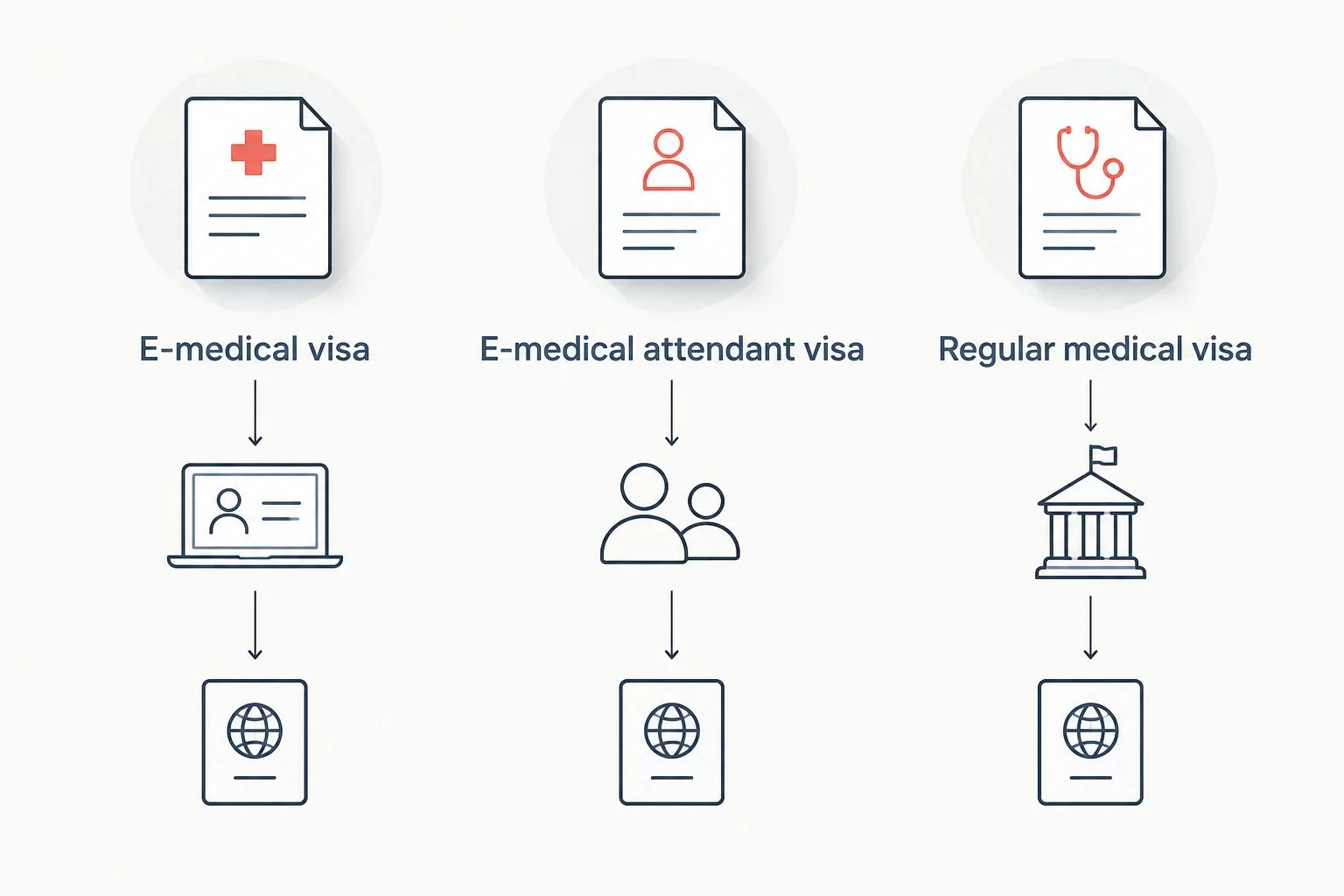
The following comparison describes planning routes, not a determination of your eligibility. Confirm the applicable conditions with India’s official visa authorities before submitting an application.
| Option | Best for | Practical advantage | Key limitation |
|---|---|---|---|
| E-medical visa | Eligible patients travelling for medical treatment within its conditions | Provides a purpose-specific electronic application route | Has defined eligibility, entry and stay conditions; it is not open-ended treatment permission |
| E-medical attendant visa | Eligible companions accompanying an e-medical patient | Provides a category for the attendant’s support role | Requires a separate application and does not replace the patient’s medical visa |
| Regular medical visa | Patients whose circumstances need assessment outside the e-medical route | Provides a route for consideration through the regular visa process | Requires its own application and supporting requirements; eligibility and conditions need official confirmation |
Start by establishing whether the e-medical conditions fit the proposed treatment. If they do not, ask the relevant Indian mission or authorised application service about the regular medical route rather than trying to fit the journey into the wrong category.
Common mistakes Australian patients make
Treating Australian residence as passport eligibility
An Australian address does not establish eligibility for an Indian e-Visa. Apply using the nationality and passport details that govern your journey, and answer the background questions accurately.
Using a tourism application for a planned treatment trip
Do not assume a tourist category covers the medical treatment you have arranged. Describe the purpose accurately and confirm the correct category through official guidance before applying.
Booking a return flight around discharge alone
Discharge means the hospital is releasing you from its care; it does not automatically establish fitness for international flying. Ask the treating clinician about travel and the airline about any clearance requirements before fixing the return itinerary.
Assuming an attendant shares the patient’s approval
A patient’s granted visa is not a family entry permit. Check the companion’s application, passport details and decision separately, even when both travellers appear on the same flight booking.
Treating the authorised stay as a treatment estimate
Visa permission describes the immigration conditions, not how long your treatment or recovery will take. Ask the hospital about scheduling uncertainty and seek official advice promptly if the medical plan no longer fits your authorised stay.
Frequently Asked Questions
Can Australian passport holders apply for an India e-medical visa?
Australian passport holders are eligible to apply under India’s e-medical framework, subject to the individual eligibility conditions. Check the official Indian e-Visa portal and use the passport you will travel on.
How long can I stay in India on an e-medical visa?
India’s published e-medical conditions provide a 60-day stay from first arrival, with triple entry. Read your granted authorisation and entry conditions before planning follow-up visits.
What hospital document do I need for an Indian e-medical visa?
The official requirements include a letter from the hospital concerned on its letterhead, identifying the proposed treatment and relevant patient details. Follow the current application checklist and ensure the patient’s identity matches the passport.
Can my partner come with me for treatment in India?
An eligible partner can apply under the e-medical attendant category when accompanying an e-medical patient. Each attendant needs a separate application, and the official framework allows up to 2 attendants per patient.
How early should I apply for an India e-medical visa?
The published application rule requires applying at least 4 days before arrival, within the stated 120-day application window. That minimum does not guarantee approval in time for a particular appointment.
Should I buy flights before my medical visa is granted?
Avoid committing to restrictive flights while visa approval and treatment dates remain unresolved. If you book earlier, read the change and cancellation conditions and understand the consequences if permission is delayed or refused.
Does an Indian medical visa mean I am fit to fly?
No, an Indian medical visa is immigration permission, not medical clearance. Ask your treating clinician about fitness to fly and the operating airline about its clearance requirements.
One last thing
Check the journey home before you leave Australia. For a 2026 treatment trip, agree with the hospital how you will obtain discharge information, follow-up instructions and any documents the airline requests. Keep the hospital contact details somewhere your carer can access without your phone.
Related guides
- Seat selection tips for long-haul flights to India
- Baggage allowance on India flights
- Comfort accessories for long-haul flights to India

