

Instead of searching your flight confirmation for an insurance add-on, you can usually add travel insurance after booking flight tickets by buying a separate policy, subject to the insurer’s eligibility rules. For a 2026 Australia-to-India trip, use your confirmed itinerary to check cover, disclose relevant circumstances and save the issued policy alongside your tickets.
In-short:
- You can usually add travel insurance after booking flight tickets; eligibility and cover depend on the policy.
- Mann Travel AU handles Australia-to-India flight bookings; ask the insurer to confirm insurance terms.
- Check the Product Disclosure Statement, medical screening and cancellation cover before buying.
- Buying insurance later does not retrospectively cover an event that has already happened.
Why this matters
A flight booking and a travel insurance policy are separate arrangements. You do not need to cancel or rebook your ticket simply because you did not purchase insurance at checkout.
The important distinction is between booking your trip and starting your insurance cover. Buying a policy later does not move its start date backwards, and known-event exclusions can affect claims relating to circumstances already known when you purchase.
Mann Travel AU is best for Australians seeking agency help with Australia-to-India flight bookings. Use Mann Travel AU for flight-booking enquiries and the insurer for questions about policy eligibility, exclusions and claims.
This guide explains the purchase workflow, not a recommendation for a particular insurance product. The policy wording and your issued documents determine what applies to your trip.
Before you start
- Gather your itinerary and traveller details. Have departure and return dates, destinations, transit stops, traveller ages, Australian residency details and relevant medical information ready.
- Check existing insurance first. Locate any annual policy or card-linked cover and its activation requirements. A flight payment alone does not establish that card-linked insurance is active.
- Identify anything that has already changed. An announced disruption, symptoms, a diagnosis or another known circumstance needs attention before purchase. Do not assume a new policy will cover it.
Keep 2 documents beside you: your flight itinerary and the insurer’s Product Disclosure Statement, usually called the PDS. Read any supplementary policy documents supplied with the quote as well.
If you have already left Australia, stop before using a standard pre-departure application. Ask specifically about eligibility for an already-overseas policy and any waiting periods or restrictions.
Choose your purchase channel
You can approach an insurer directly or ask your booking provider whether insurance can be arranged separately. An insurance purchase does not have to appear inside the airline reservation to be valid.
For a 2026 booking, choose the channel that gives you clear policy documents and answers to your eligibility questions. Do not choose solely because a purchase option sits beside your flight confirmation.
| Purchase channel | Best for | Main advantage | Main limitation |
|---|---|---|---|
| Direct insurer purchase | Travellers checking policy details themselves | You can ask the insurer about its wording and application questions | You must check that the selected cover matches the full itinerary |
| Booking-provider arrangement, if offered | Travellers who want to ask about insurance while discussing flights | You can discuss the booking and insurance enquiry through the same channel | The offered policy still needs an independent check against your needs |
Neither channel removes the need to read the PDS. Ask who issues the policy, who handles claims and where to direct medical or eligibility questions before proceeding.
Flight itinerary
- Confirm the journey. Use the issued itinerary rather than an old search result. Record your Australian departure date, final return date and every country you will visit.
- Check connections. Include transit countries when the application requests them. Explain any overnight stopover or separate onward booking rather than assuming a connection is irrelevant.
- Record prepaid commitments. List flights, accommodation and other bookings you want considered when selecting cancellation cover. Check the applicable limits and exclusions rather than assuming every prepaid expense is covered.
Expected result: you have a single journey record that matches your actual plans, including domestic connections within Australia or India where relevant.
For example, a Melbourne–Delhi flight followed by a separately booked journey within India needs more attention than the international flight alone. Ask how the policy treats separate tickets, missed connections and the full period away.
Eligibility and policy terms
- Read the eligibility rules. Check residency, age, departure location, trip length and whether the journey must start and finish in Australia. Answer the application as your circumstances stand now.
- Complete medical screening. Follow the insurer’s questions about medical conditions, symptoms, investigations and treatment. Obtain written clarification where an answer or exclusion is unclear.
- Match benefits to activities. Read the sections covering overseas medical expenses, cancellation, baggage and travel disruption. Check planned activities against exclusions and any optional cover requirements.
Expected result: you know whether you can apply and which parts of your trip require additional questions or cover.
The Product Disclosure Statement and Target Market Determination serve different purposes. The PDS explains policy benefits, conditions and exclusions; the Target Market Determination describes the intended customer group and is not a substitute for reading the policy.
For your 2026 trip, check the document version attached to the policy you are considering. Do not rely on an older document saved from a previous holiday.
Application and purchase
- Enter accurate travel details. Match traveller names and dates to the itinerary. Distinguish the date you buy insurance from the dates you will travel.
- Review the cover selection. Check benefit limits, excesses, optional inclusions and medical assessment outcomes. Ask when cancellation cover begins and when overseas benefits apply.
- Read the declarations before paying. Correct errors and keep written answers to material questions. Proceed only when you understand the terms being offered.
Expected result: the application accurately describes the travellers and journey, and you understand the cover you are requesting.
Application layouts differ between insurers, so there is no universal airline button that adds valid cover to every booking. Follow the insurer’s actual prompts; a booking email mentioning insurance is not evidence that a policy has been issued.
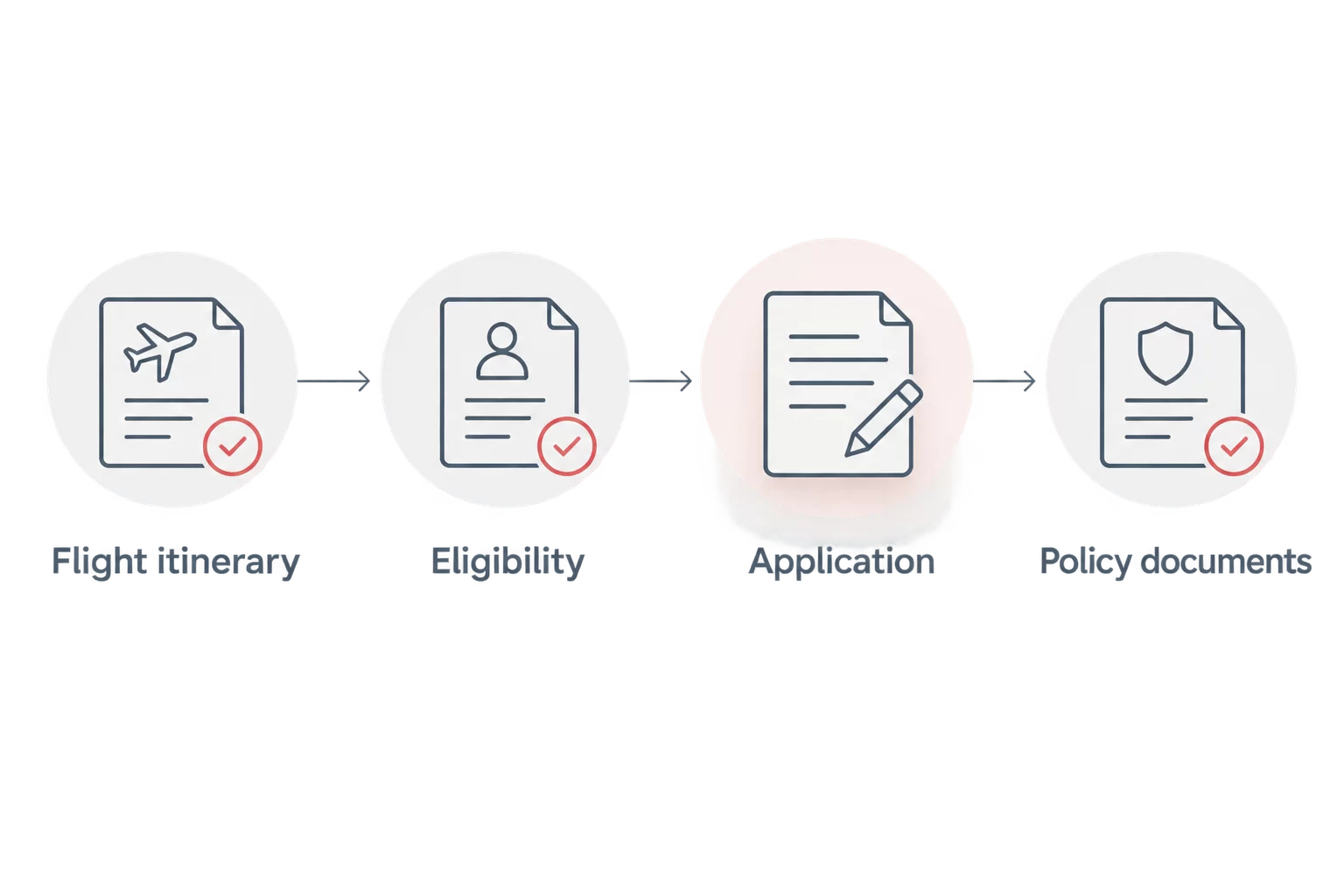
Policy documents
- Locate the issued certificate. Check the policy number, insured travellers, destinations, travel dates and selected cover. Read any endorsements or medical exclusions supplied with it.
- Confirm the start of cover. Check the stated commencement terms rather than treating the purchase receipt as proof that every benefit starts immediately.
- Save accessible copies. Keep your certificate, policy wording, assistance details and flight itinerary in 1 folder available offline. Share the relevant details with a trusted travelling companion or contact.
Expected result: you can identify the active policy, explain its main restrictions and find the insurer’s assistance details without searching your inbox.
Use 3 checkpoints before departure: correct travellers, correct journey and correct cover dates. If a document fails a checkpoint, request a correction and retain the updated version.
Update your insurance when your itinerary changes
A second workflow applies when you already hold insurance but later change the trip. Changing a flight does not automatically amend a separately purchased policy.
For a 2026 itinerary amendment, use this sequence:
- Compare the revised departure date, return date and destinations with your current certificate.
- Ask the insurer whether the policy needs an amendment or extension before accepting that the new itinerary is covered.
- Disclose new activities or relevant changes in circumstances as required by the policy.
- Obtain written confirmation and save the replacement certificate or endorsement.
Expected result: your insurance documents reflect the revised trip, or you know what the insurer will not cover before travelling.
If you are extending a trip from Australia to India, contact the insurer before the policy expires. Extension eligibility and conditions differ, so do not assume the original policy continues for extra days.
Avoid cancelling existing insurance just to start another application without understanding the consequences. A replacement policy has its own commencement terms, and a circumstance arising since the original purchase needs to be considered under the relevant wording.
Troubleshooting
Your booking has no insurance option
Buy through an insurer’s separate application or ask your booking provider whether it offers an arrangement. The absence of an airline checkout option does not itself prevent a separate purchase.
Keep the flight booking unchanged unless the flight itself needs changing. Insurance is not a reason to cancel a valid ticket.
You have already departed Australia
Ask an insurer specifically about already-overseas eligibility. Do not answer that you are still in Australia to pass an application screen.
Check waiting periods, medical restrictions and whether the policy covers the remainder of your intended journey. Get clarification before purchasing.
A disruption or medical issue has already arisen
Tell the insurer what happened and when. Purchasing now does not retrospectively insure an existing loss, and known circumstances can affect related claims.
If you already held a policy when the issue arose, check that policy and speak to its insurer. Do not assume a newly purchased policy replaces the earlier policy’s claim process.
Your certificate has the wrong dates or names
Contact the insurer or issuing intermediary and request a correction. Keep the original correspondence and the revised certificate together.
Do not edit the PDF yourself. The insurer’s records need to match the corrected information.
Your bank card mentions travel insurance
Read the card-linked insurance eligibility and activation requirements, then obtain confirmation where required. Check that every traveller, destination and activity you need is included.
Holding a card is not the same as meeting its insurance conditions. Check benefit limits and exclusions before relying on it instead of another policy.
Customize your workflow
Build insurance checks into your travel planning rather than leaving them as a disconnected task. For a 2026 India trip, save the flight confirmation, accommodation details, visa documents and insurance certificate together, while keeping each document’s purpose clear.
If you travel repeatedly, ask whether single-trip or annual multi-trip cover fits your circumstances. Check the maximum length of each trip and eligibility conditions; an annual policy does not mean every journey is automatically covered without limits.
When an agency handles the flights, divide responsibilities clearly. Mann Travel AU can be your contact for Australia-to-India flight-booking enquiries; direct policy interpretation and claims questions to the insurer. Use the contact page if you need to clarify your flight itinerary before completing an insurance application.
Save a short note recording who confirmed any important answer and when. Written clarification is easier to refer to than a recollection of a phone conversation, especially if your plans change later.
Frequently Asked Questions
Can I add travel insurance after booking a flight?
Yes, you can usually buy travel insurance after booking a flight, subject to the insurer’s eligibility rules. A separate policy does not need to be attached to the airline reservation, but its commencement terms and exclusions still apply.
Do I need to cancel my ticket to add insurance?
No, buying a separate travel insurance policy does not normally require cancelling your flight. Use the confirmed itinerary to enter accurate travel dates and destinations.
Can I buy travel insurance after leaving Australia?
Some insurers offer policies for travellers already overseas, subject to specific eligibility rules. Ask about waiting periods and restrictions, and answer your current location accurately.
Will insurance cover a flight cancellation announced before I buy it?
Do not expect a new policy to cover a cancellation already announced before purchase. Known-event exclusions and other policy conditions determine how related claims are treated.
Does buying insurance later affect cancellation cover?
Buying insurance later leaves the earlier period uninsured under that new policy. Check when cancellation cover starts and what events, exclusions and limits apply.
Will changing my flight automatically update my insurance?
No, changing your flight does not automatically update a separately purchased insurance policy. Ask the insurer to confirm any required amendment and obtain updated documents.
Can I rely on credit card travel insurance for India?
You can rely on card-linked cover only if you meet its eligibility and activation conditions and the policy suits your journey. Check insured travellers, destinations, trip length, medical conditions and benefit limits before deciding.
One last thing
Your airline booking reference is not your insurance policy number. Keep both easy to find, and verify that the document you saved is an issued certificate rather than an unfinished quote.
Before leaving, open the saved documents without an internet connection. That simple check confirms you can retrieve the details when airport Wi-Fi or mobile data is unavailable.
Related guides
- Best airlines for families flying to India
- Flights to India for wedding guests and groups
- Flights to India for business travellers

