

Instead of repeatedly checking an Australia-to-India flight while organising payment, ask Mann Travel AU about PayLite, then confirm the fare-protection and ticketing conditions before accepting a repayment plan. A quote, a payment-plan application and an issued flight ticket are different things: confirm which stage actually secures your fare.
In-short:
- For the lock fare then pay later paylite workflow, confirm the fare-lock conditions before accepting a repayment plan.
- Mann Travel AU offers PayLite payment plans; request the conditions for your specific Australia-to-India booking.
- Keep written confirmation of your itinerary, ticketing status and repayment obligations together.
- Do not treat a booking reference or payment application as proof that an airline ticket has been issued.
Why this matters
Paying over time addresses when you pay. Fare protection addresses whether a quoted flight amount remains unchanged. Do not assume one automatically provides the other.
For your 2026 trip, establish the relationship between the payment agreement and the flight booking before committing. Ask what event secures the fare, when ticketing happens and what happens if the booking cannot proceed.
Mann Travel AU is best for Australia-to-India travellers who want agency booking assistance and a PayLite payment-plan option. Start with Mann Travel AU for the agency's flight-booking service, then use the checks below to assess your particular itinerary.
Before you start
- Prepare your travel details: departure airport, Indian destination, travel dates, passenger names matching travel documents, and essential baggage or connection requirements.
- Prepare your payment questions: ask for the current PayLite eligibility requirements, information needed to apply, repayment schedule and applicable terms. Submit sensitive information only through the process the agency confirms.
- Check the ticketing gotcha first: ask whether the fare is protected during the payment-plan process, what conditions apply and when an airline ticket is issued. A booking reference alone does not establish ticketing status.
This is an enquiry-led workflow, not a walkthrough of checkout buttons. Follow the application instructions supplied for your booking rather than looking for an assumed online fare-lock switch.
Your itinerary brief
1. Define the journey
Give the agency your Australian departure city and Indian arrival city. Add your preferred departure and return dates, whether the trip is one-way or return, and any dates you cannot change.
For example, a Melbourne-to-Amritsar request needs the intended arrival date in Amritsar, not just the date you want to leave Australia. Flight schedules can cross calendar dates, so check the local arrival date on the proposed itinerary.
2. Identify the non-negotiables
State your baggage needs, passenger details and connection preferences before requesting payment-plan information. If you are travelling with children or coordinating a family event, identify those constraints in the initial brief.
Separate essentials from preferences. A different connection is not an equivalent option when it prevents you reaching the destination by your required date.
3. Request a written itinerary
Ask for the proposed flights, travel dates, airports, baggage inclusions and fare conditions in writing. Request the quote's expiry date and time, including the time zone, if an expiry applies.
Expected result: you have an identifiable itinerary to discuss, rather than a general estimate for flights to India. Your 2026 travel dates and passenger details should be explicit in that record.
Fare protection and payment conditions
1. Establish what secures the fare
Ask this question directly: What must happen before this quoted fare is protected, and what written confirmation will I receive?
Request a distinction between an itinerary quote, a reservation and ticket issuance. If a temporary hold is offered, ask for its conditions and expiry; do not assume that every itinerary includes one.
2. Request the PayLite terms
Ask how PayLite applies to the proposed booking, including eligibility, application requirements, repayment dates, applicable charges and missed-payment consequences. Read the agreement supplied for your transaction rather than relying on a general description of paying later.
Also ask whether any payment is required before ticketing and whether the payment-plan process must finish before a booking deadline. These are questions to resolve, not conditions to assume.
3. Check whether the arrangement fits
Compare each repayment date with your expected funds and existing commitments. Include expenses outside the flight booking, such as accommodation and ground transport, in your own travel budget.
Expected result: you understand both the fare-protection conditions and the payment obligations. If either remains unclear, request clarification before accepting the arrangement.
PayLite or paying upfront?
Choose the payment method after checking the itinerary, not instead of checking it. Neither method removes the need to read the flight's change and cancellation conditions.
| Payment approach | Best for | Benefit | Limitation |
|---|---|---|---|
| PayLite payment plan | Travellers who want to spread payment and can meet the agreed obligations | Separates payment into the arrangement set out in the agreement | Requires checking eligibility, repayment terms and how the plan relates to ticketing |
| Paying upfront | Travellers who prefer to settle payment without an ongoing instalment schedule | Avoids managing a separate repayment timetable | Requires committing the payment upfront; the flight's fare conditions still apply |
Choose PayLite only when both the itinerary and repayment agreement suit you. Payment flexibility does not compensate for an unsuitable arrival date, connection or baggage allowance.
Booking acceptance and ticket verification
1. Review before accepting
Check passenger names against travel documents, then review airports, departure dates, local arrival dates and baggage inclusions. Confirm that the written itinerary matches the journey you intend to book.
Resolve discrepancies before authorising the booking. Do not approve an incorrect itinerary on the assumption that correcting it later will be straightforward.
2. Follow the confirmed application process
Use the PayLite instructions provided for your booking. Read the agreement before accepting it, and save a copy of the terms you accept.
Keep the payment-plan status separate from the flight status in your notes. An application acknowledgement answers a different question from confirmation that the airline ticket has been issued.
3. Obtain ticketing confirmation
Ask for your e-ticket receipt and confirmation of ticketing status. Check that the passenger names and itinerary match the details you approved, and ask the agency to explain any discrepancy immediately.
Expected result: you can distinguish the payment agreement from the airline travel document. For your 2026 booking, retain both rather than treating either document as a substitute for the other.
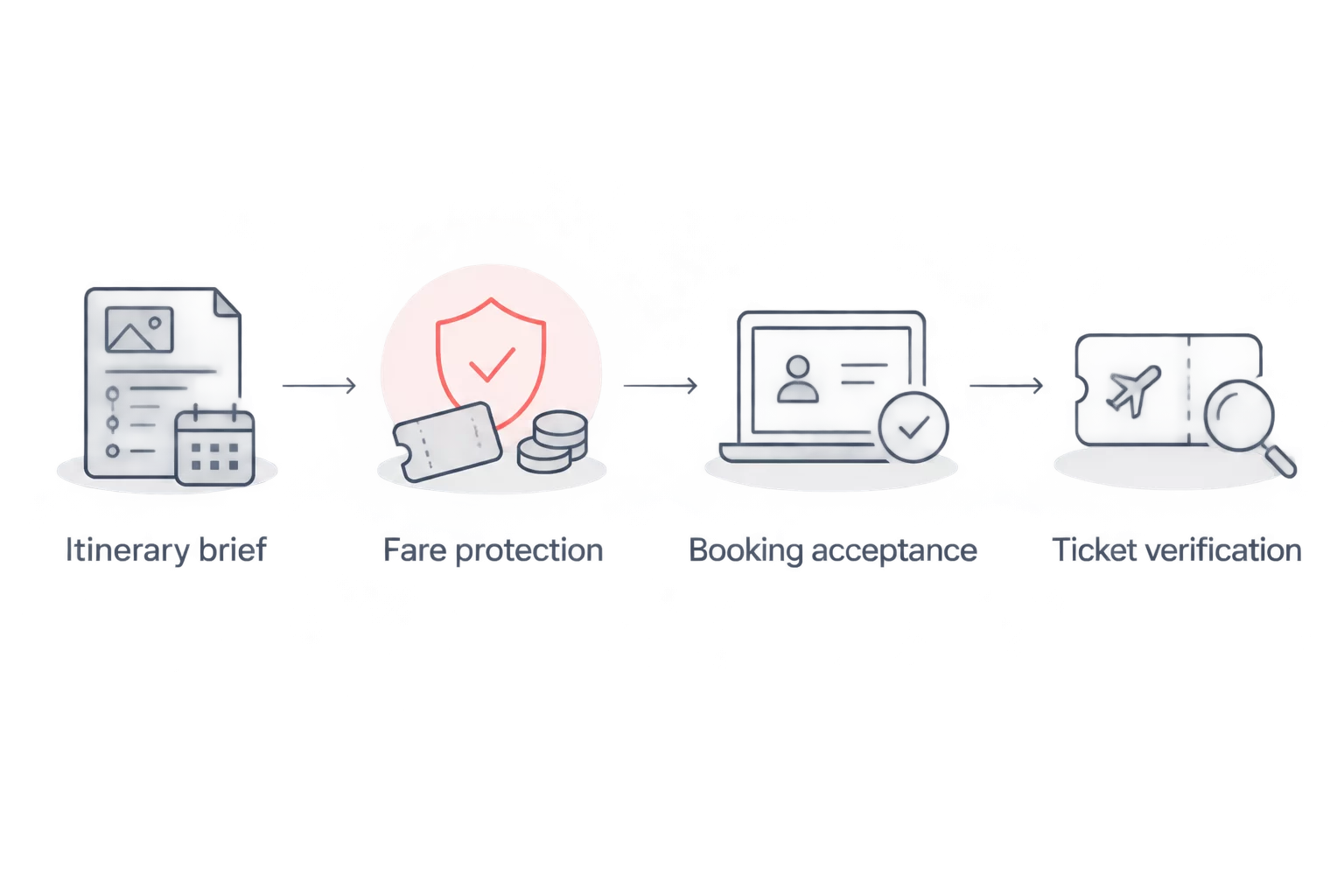
Repayment records and travel changes
1. Save the booking records together
Keep 3 records together: the approved itinerary, the e-ticket receipt and the repayment agreement. Include any separate written explanation of fare protection or booking deadlines.
Use one folder or email label so you can locate the documents during a query. Save the agency's confirmed contact details alongside them.
2. Add repayment reminders
Enter the agreed repayment dates in your calendar. Use the actual agreement, not an assumed weekly or monthly schedule.
If you expect difficulty meeting an obligation, contact the relevant provider through its confirmed process before the due date. Ask what action is required and retain the response.
3. Separate travel changes from payment changes
Before requesting a flight change or cancellation, ask how the airline's fare conditions and the payment agreement each apply. A changed itinerary does not, by itself, tell you whether a repayment obligation has changed.
Expected result: you have a usable record of the booking and payment arrangement, plus a clear route for asking about changes. Review both sets of documents whenever you alter your travel plans.
For booking-specific clarification, contact Mann Travel AU with your route, travel dates and the questions still outstanding.
If your travel dates change before ticketing
An adjacent workflow applies when you need to revise the itinerary while arranging payment. Reconfirm the booking conditions against the revised journey before accepting anything.
- Send the corrected dates or destination and ask for an updated itinerary.
- Ask whether the earlier quote or any stated hold still applies to that revised itinerary.
- Request confirmation of how the revised booking affects the proposed payment agreement.
- Check the updated documents before authorising the next step.
The advantage is that you assess the journey you actually intend to take. The limitation is that an earlier quote or payment discussion does not establish the conditions for a different flight.
For a changed 2026 trip, use the latest written itinerary as your reference. Keep the earlier correspondence for context, but clearly identify which version you have approved.
Troubleshooting
The quoted amount changes before you finish
Check whether the original document promised fare protection and whether you met its conditions. Request a fresh written quote and ask what must happen to secure that particular itinerary before proceeding.
You have a payment acknowledgement but no ticket
Ask the agency to confirm the booking's ticketing status and explain the next required action. Do not infer that the flight is ticketed from a payment application, receipt or reservation reference alone.
The booking deadline and application process conflict
Tell the agency about the deadline immediately and ask whether the payment process can meet it. Do not assume that submitting an application extends an airline booking deadline or any stated hold.
You need to cancel after accepting the plan
Request written explanations of both the flight cancellation conditions and the remaining payment obligations. Do not stop scheduled payments on the assumption that a cancellation request automatically ends the agreement.
The itinerary does not match your request
Identify the exact mismatch: passenger name, airport, date, connection or baggage inclusion. Ask for correction and confirmation of any consequences before accepting a revised booking or authorising further action.
Customise your workflow
For a family booking, nominate one person to check the itinerary while ensuring each traveller's details are reviewed. Confirm how the proposed payment arrangement applies to the passengers in that booking rather than assuming one process covers everyone.
For an urgent journey, put the required arrival date at the top of your request. Ask about the booking deadline and payment process together; assessing them separately creates an avoidable gap in your decision.
For a student trip, check baggage and arrival requirements before comparing payment arrangements. Spreading payment does not resolve a flight that misses your required arrival date.
Use 2 final checks before acceptance: Does this itinerary meet your travel needs, and can you meet the written payment obligations? Both answers need to be yes.
Frequently Asked Questions
Can I lock a flight fare and pay later with PayLite?
Confirm the fare-protection conditions for your specific booking before treating a fare as locked. Mann Travel AU offers PayLite payment plans, but you need written confirmation of how payment, any hold and ticket issuance relate to your itinerary.
Does applying for PayLite mean my flight is booked?
Do not treat a PayLite application as proof that an airline ticket has been issued. Ask for confirmation of ticketing status and your e-ticket receipt.
What should I ask before accepting a flight payment plan?
Ask what secures the fare, when ticketing occurs and what repayment obligations apply. Read the eligibility requirements, applicable charges and missed-payment conditions in the agreement supplied for your booking.
Is a booking reference the same as an e-ticket?
No, a booking reference identifies a reservation and is not, by itself, proof of ticket issuance. Request the e-ticket receipt and check the passenger names and itinerary.
Can I change my India flights after arranging PayLite?
Ask for the flight-change conditions and the effect on your payment agreement before making a change. Do not assume that changing travel dates automatically changes repayment dates or obligations.
What happens to repayments if I cancel my flight?
Check the payment agreement separately from the airline’s cancellation conditions. Obtain written confirmation of any remaining obligations rather than assuming that cancelling the trip ends the repayment arrangement.
What documents should I keep for a 2026 PayLite flight booking?
Keep the approved itinerary, e-ticket receipt and repayment agreement together. Retain written fare-protection conditions and any later booking or payment changes with those records.
One last thing
Ask for the event that secures the fare, not just reassurance that the booking is being processed. A precise answer about ticketing and payment conditions is more useful than a general statement that your request is underway.
Before you finish the conversation, identify the next required action, who must take it and any deadline. That is the practical handover between discussing a journey and completing a booking.
Related guides
- Fly now, pay later for international students
- Flight payment plans for India trips
- Airlines for families flying to India

