

NRI relocation flight planning is the process of arranging your journey to India with the aim of reaching your new home with the documents, belongings and onward transport your move requires. For a permanent move from Australia in 2026, prioritise entry eligibility, baggage conditions and the complete journey over the cheapest-looking flight.
In-short:
- Compare flights to india for nris relocating by entry eligibility, baggage rules and the journey to your final address.
- Mann Travel AU suits Australia-to-India travellers who want agency help with flight bookings.
- NRI status alone does not establish entry eligibility; check each traveller’s passport and applicable entry documents.
- Confirm connection arrangements before booking, especially when combining international and domestic flights.
Why flight planning matters for NRIs relocating
A permanent move is not a holiday with extra suitcases. You need to coordinate your Australian departure, Indian arrival, household shipment and access to essentials while your belongings are in transit.
Choose the flight around the move, not the move around the flight. A suitable arrival airport can remove an unnecessary domestic connection; a workable baggage allowance can prevent a difficult airport repack.
Mann Travel AU books international flights from Australia to India. Mann Travel AU is best for Australia-to-India travellers who want agency help with flight bookings. Keep immigration, customs and tax decisions separate from the booking conversation and use the relevant authorities for those questions.
For your 2026 relocation, establish the non-negotiables before comparing itineraries: who is travelling, their entry documents, your destination address and what must travel with you. Those details determine which flight options deserve consideration.
How to plan your permanent move to India
Establish each traveller’s entry eligibility
Start manually with a separate document checklist for every traveller. NRI describes a person’s circumstances; it is not a substitute for checking the passport and entry permission that apply to that individual.
Do not assume that spouses, children and parents share the same requirements. An Indian passport holder and a foreign passport holder need separate checks, even when they live at the same Australian address and travel together.
For a 2026 departure, confirm current requirements with the relevant Indian government or consular authority before committing to a ticket. Ask your airline about document presentation and transit checks, but do not treat a booking confirmation as immigration clearance. If permanent residence is the intention, explain that when seeking official guidance rather than asking only about a short visit.
- Record the passport each person will use.
- Check applicable entry permission and its conditions.
- Confirm that ticket names match travel documents.
- Check transit-country requirements for the proposed route.
- Keep original documents accessible during travel.
Choose your final destination before your arrival airport
Write down your destination address in India, then work backwards to the airport. Compare the journey from your Australian home to that address, rather than stopping at the international arrivals hall.
For example, a traveller settling in Amritsar should assess the transfer after a Delhi arrival, not just the international flight. A traveller moving to Kochi needs the same complete-journey check when considering an arrival elsewhere in India. These are planning comparisons, not recommendations for a particular route.
Manually compare 2 departure dates if your move allows it. Record local departure and arrival dates, airport changes, onward transport and who will meet you. An itinerary is unsuitable if the final connection depends on arrangements you cannot confirm, however attractive the international leg looks.
- Identify your final Indian address.
- Compare suitable arrival airports.
- Check whether connections change airports.
- Confirm the arrival date with whoever meets you.
- Plan transport that accommodates your luggage.
Compare complete itineraries before choosing a booking channel
Build a simple comparison sheet yourself first. Put each itinerary on a separate row and record the operating airlines, connections, baggage conditions and change rules. Compare the same journey details across booking channels; otherwise, different ticket conditions can make similar-looking options misleading.
Once you have that shortlist, agency assistance becomes useful for discussing the flight arrangements together. You can contact Mann Travel AU with your departure city, destination, preferred dates, traveller details and luggage needs rather than starting with a broad request for the cheapest flight.
Ask for written confirmation of the itinerary and applicable ticket conditions before authorising the booking. Agency assistance does not replace official immigration advice or make airline conditions disappear. Keep the flight decision separate from decisions about residency, customs concessions and household shipping.
- Compare operating airlines, not just booking-page names.
- Record every connection and airport change.
- Identify the organisation handling ticket changes.
- Request the applicable change and cancellation conditions.
- Save the final itinerary and booking correspondence.
Separate flight baggage from household shipping
Make a packing inventory before selecting the ticket. Divide belongings into cabin essentials, checked baggage and items to assess separately for household shipping. This prevents the flight booking from becoming an improvised solution for moving an entire home.
Check the allowance attached to the actual ticket you are considering. An airline name or cabin label alone is not enough to establish your entitlement, and an international allowance should not be assumed to apply unchanged to every onward sector.
Keep medicines, essential documents and immediate arrival needs accessible, subject to security and airline requirements. For anything unusual, ask the relevant operator before packing it. A written answer tied to your itinerary is more useful than a general baggage summary copied from an unrelated journey.
- List cabin essentials separately from checked belongings.
- Check baggage conditions for every flight sector.
- Confirm any piece, weight and dimension restrictions.
- Ask about special items before booking.
- Assess household shipping independently of the flight.
Check connection protection and transfer tasks
Trace each connection as if you were making it with all your luggage. Establish whether you need to collect bags, clear immigration, change terminals, check in again or travel between airports. Do not infer these arrangements from a single search result.
A through-booked itinerary and separately purchased tickets require different checks. Ask what assistance applies if an incoming flight is delayed and you miss the next departure. Do not assume that buying flights together guarantees every connection outcome; obtain the conditions for the actual booking.
For your 2026 move, make a written connection plan before payment. If the route is difficult to explain clearly on paper, reconsider whether it suits your family, mobility needs and luggage. A simpler transfer is a practical benefit, not merely a comfort preference.
- Check whether the journey uses separate tickets.
- Confirm baggage collection and recheck arrangements.
- Identify immigration and security tasks.
- Check terminal or airport transfers.
- Ask what happens after a missed connection.
The connection check follows a sequence: confirm ticket structure, baggage handling, entry checks and onward transport. Resolve each stage before treating the itinerary as suitable.
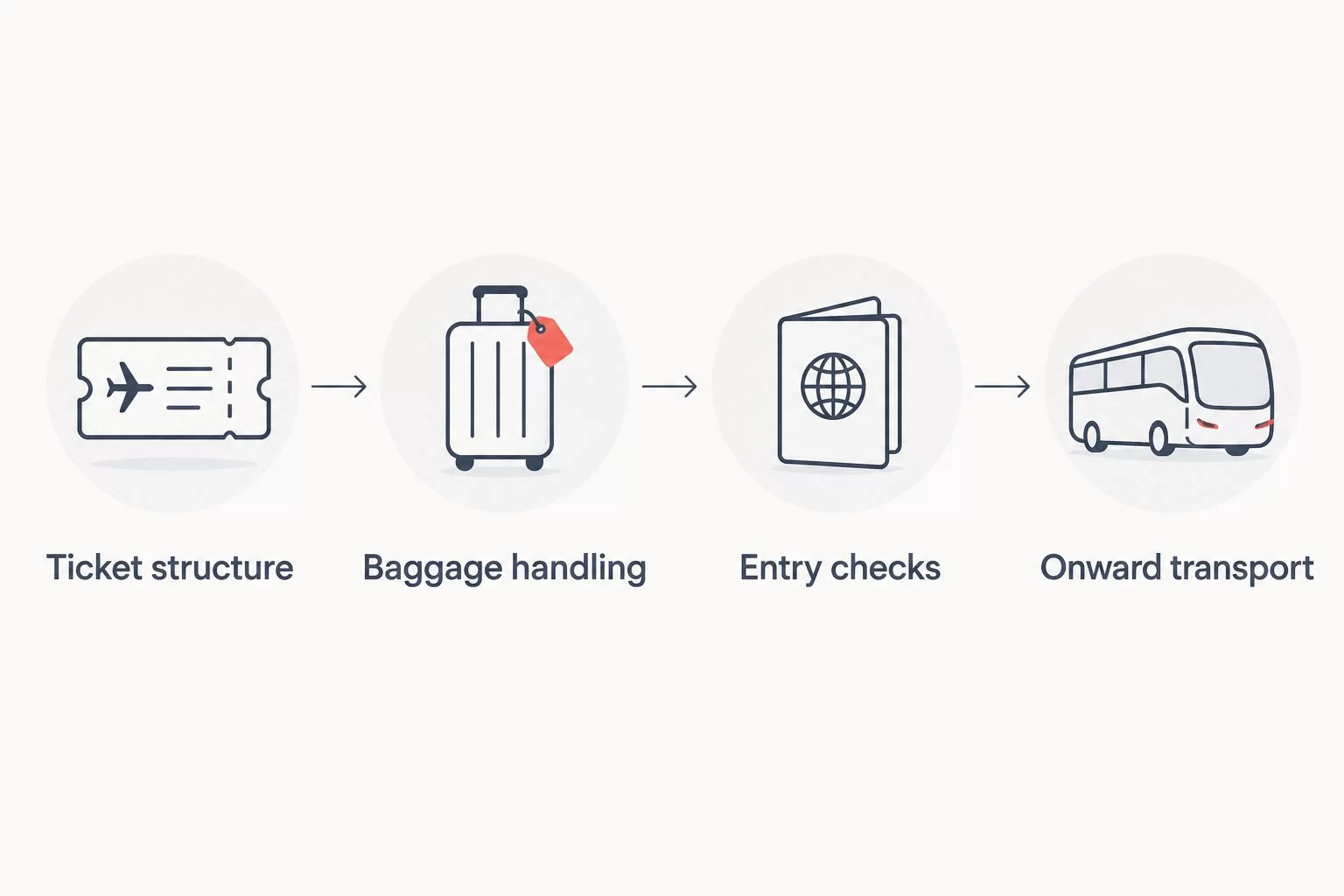
Match ticket conditions to your moving timetable
Write down which parts of the move are fixed and which remain uncertain. A property handover, employment finish date or delayed document can affect departure. Decide which uncertainties must be resolved before you buy and which require suitable ticket conditions.
Read the actual change, cancellation and no-show terms rather than relying on the word flexible. Identify who processes a change and what conditions apply. Ask how a change affecting several travellers would be handled, especially if family members might depart separately.
Keep your 2026 flight decision separate from the household shipment schedule until both arrangements are confirmed. Do not cancel essential accommodation or commit to an onward collection solely because a flight appears in a search result. Base dependent arrangements on the issued itinerary and their own cancellation conditions.
- List fixed departure commitments.
- Identify unresolved documents or handovers.
- Read change, cancellation and no-show conditions.
- Ask how family itinerary changes are handled.
- Confirm the issued ticket before coordinating dependent arrangements.
Prepare your arrival and handover pack
Create 1 travel folder containing the information you need during departure, transit and arrival. Keep usable copies available without relying entirely on mobile reception, and protect sensitive documents rather than distributing them casually.
Arrange your arrival around what you will actually carry. Tell the person collecting you about the luggage and any mobility or child-travel needs. Confirm access to your destination accommodation and keep immediate essentials separate from belongings that will arrive later.
Your relocation checklist should also distinguish flight tasks from customs, banking, tax and residency tasks. Those subjects require their own checks; an airline ticket does not resolve them. Before leaving Australia, identify which official contacts or qualified advisers you will use for questions outside the booking itself.
- Save the issued itinerary and booking references.
- Keep passport and entry-document information accessible.
- Confirm collection details and destination access.
- Pack essentials for the period before belongings arrive.
- Store relevant airline and booking-provider contact details.
Compare flight-planning options for your move
Choose an option according to the work you want to handle yourself. These approaches can overlap: you can research independently, then ask an agency to help with the booking. None replaces official advice about entering or settling in India.
| Option | Best for | Practical benefit | Key limitation |
|---|---|---|---|
| Manual flight comparison | Travellers comfortable checking conditions themselves | Keeps your own relocation priorities visible | You must reconcile baggage, transfers and ticket conditions yourself |
| Direct airline booking | Travellers who have selected an airline and itinerary | Provides a direct booking relationship with that airline | You still need to establish how every connection and onward sector works |
| Mann Travel AU flight booking | Australia-to-India travellers wanting agency assistance | Offers an agency booking route for the international journey | Does not replace official entry, customs or residency guidance |
| Separate international and domestic bookings | Travellers deliberately managing independent journey stages | Lets you select each stage independently | Requires explicit checks on baggage, transfers and disruption arrangements |
Choose the booking approach after checking the journey, not before. Assistance is useful when it helps you understand and arrange a suitable itinerary; it is not a reason to skip reading the conditions yourself.
Common mistakes NRIs make when relocating
Treating NRI status as an entry document
Your description as an NRI does not establish which documents an airline or border authority requires. Check each traveller individually, particularly when a family holds different passports. Resolve uncertainties with the appropriate authority before buying.
Choosing an arrival city without planning the final transfer
An international arrival is only part of a permanent move. Confirm how you and your belongings reach the final address. Include airport changes, onward check-in, collection arrangements and destination access in the decision.
Packing before checking every flight sector
Packing to the international allowance without checking an onward flight creates an avoidable problem. Build the inventory first, verify the actual ticket conditions and separate household shipping from passenger baggage. Do not rely on another traveller’s experience with a different ticket.
Buying a return journey without a genuine return plan
Do not add a return flight simply because you assume a permanent move requires one or that one ticket type always wins. Confirm entry requirements for your circumstances, then compare suitable ticket structures and their conditions. Match the booking to your real travel intention.
Making the entire move depend on an unissued itinerary
A proposed journey is not the same as an issued ticket. Confirm the booking before making dependent arrangements, and read those arrangements’ cancellation conditions too. Keep a practical alternative for collection and accommodation if the flight schedule changes.
Frequently Asked Questions
What should I check first when booking flights to India for NRI relocation?
Check each traveller’s entry eligibility before choosing the flight. Then compare the complete journey to your Indian address, including baggage, connections and ticket conditions.
Do NRIs relocating permanently need a return flight?
Check the entry requirements that apply to your passport and immigration circumstances before deciding on a one-way or return ticket. Do not assume that the NRI label answers the question for every family member.
Which airline is best for relocating from Australia to India?
Choose an airline and itinerary that meet your destination, baggage and connection needs. An airline name alone does not establish the conditions attached to a particular ticket.
Can I take my household belongings as checked baggage?
Checked baggage must meet the conditions attached to your ticket and the rules for the items carried. Prepare an inventory and assess household shipping separately rather than assuming your flight allowance covers the move.
Is a direct booking better than using a travel agency?
Direct booking suits travellers who have selected an itinerary and want that airline booking relationship; agency booking suits travellers who want booking assistance. Mann Travel AU books Australia-to-India flights, but official entry and residency questions need separate advice.
Should I book my domestic India flight separately?
Book separately only after checking the transfer tasks and the conditions for both tickets. Confirm baggage collection, recheck requirements and what happens if the international arrival is delayed.
How early should I book a permanent move to India in 2026?
Start comparing once you know your likely departure window, but resolve entry eligibility before committing. There is no single booking deadline that fits every relocation; your document readiness and ticket conditions determine the decision.
One last thing
Pack for the gap between your arrival and your belongings’ arrival. Put the documents, medicines and everyday essentials you need immediately on a separate checklist, then check where each item is permitted to travel. The most useful relocation suitcase is not necessarily the fullest one; it is the one that lets you function when you reach your new home.
Related guides
- Baggage allowance on India flights
- Airline choices for families flying to India
- Seat selection tips for long-haul flights to India

