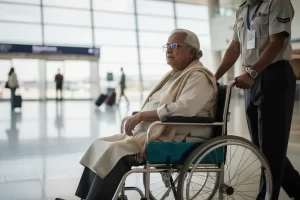

Traveling can be challenging for passengers with reduced mobility or special needs, but the right support and additional assistance make it easier and more comfortable. Wheelchair assistance and special services on Australia to India flights help passengers navigate airports, board and disembark safely, and manage mobility aids throughout their journey. These services reduce stress by assisting individuals in busy airports and promote access to essential services and social inclusion. This guide covers key information to ensure a smooth, stress-free travel experience for travelers requiring wheelchair assistance and special support.
Inshorts: Wheelchair Assistance in the Aircraft Cabin
Pre-book wheelchair and special assistance when booking your flight.
Request special services such as wheelchair assistance, medical support, or mobility aid handling when booking your flight.
Inform the airline at least 48-72 hours before the scheduled departure time to allow for necessary arrangements.
Passengers who require assistance should notify the airline as early as possible.
Arrive early at the airport — at least 2 hours before international flights.
Assistance covers check-in, security, boarding, and baggage handling.
Caregivers or an accompanying passenger can travel together but must be physically able.
Medical clearance may be required for special conditions or equipment.
Use airline and airport special assistance desks for support on your journey.
Traveling Made Easier for Everyone with Battery Powered Mobility Aid Support and Manual Wheelchair Options
For Indians traveling to or from Australia, airports and airlines understand that some passengers need extra help. Airlines provide assistance to travelers who require assistance due to age, injury, or medical condition. Whether you’re an elderly family member, a student with mobility challenges, or a professional recovering from an injury, requesting wheelchair or special assistance flights can make your trip smooth and less stressful.
Flight assistance for elderly travelers is also available to ensure their comfort and safety. Medical assistance is available for those with a medical condition, and travelers should inform the airline if they require such support. This flight support for passengers with reduced mobility is designed to meet diverse needs and provide a dignified travel experience.
To further ease your journey, consider consulting the OCI & e-Visa Guide for Australia to India travellers to ensure your travel documents are in order.
Step 1: Understand the Types of Assistance Available and Other Assistive Devices
Wheelchair Assistance: Available for passengers who cannot walk long distances or need help from arrival at the airport, check-in, security, boarding, and disembarking.
Mobility Assistance: Support is available for passengers with mobility challenges, including transfer to and from the aircraft and assistance with boarding.
Mobility Aids: You can travel with your own wheelchair or mobility device (battery or manual) if it meets size and safety rules. Usually, it will be checked in and replaced with an airport wheelchair. Manual wheelchairs must fit upright within size limits; otherwise, airlines may offer an alternative mobility aid.
Caregiver Support: Passengers needing a caregiver can request to sit together. The caregiver should be able to assist during the flight and emergencies. Special support is available for visually impaired travelers, including help with airport navigation and onboard safety information.
Passengers with hearing impairment or visual impairment can request tailored support, such as escorts, safety briefings, or accessible information.
Passengers with cognitive impairment are also eligible for special assistance and should notify the airline of their needs.
Step 2: Inform the Airline in Advance and Check-in Procedures
When booking your flight, indicate your need for specific assistance clearly and ensure it is requested prior to the scheduled departure time. Airlines like Air India ask you to share your exact requirements such as carrying appropriate medical documentation, like a notification card or medical certificates, when requesting special assistance.
Assistance from curbside to check-in counter
Wheelchair from check-in to boarding gate and assistance with transfer to your aircraft seat
Help during boarding and disembarking
Details about any personal medical equipment or aids, including own medication
Passengers traveling with their own mobility aid can surrender it at check-in or at the departure gate.
Mobility aids that cannot be carried in the cabin will be checked in as checked baggage and handled with care according to airline procedures.
Assistance at the airport includes help with check-in, security screening, and transfer to your aircraft seat.
Notify the airline at least 48 to 72 hours before your flight to ensure smooth arrangements and availability of any additional assistance.
Step 3: Medical Clearance and Documentation
Passengers with serious medical conditions may be required to submit a Medical Information Form (MEDIF) signed by a physician. This is to ensure your safety during the flight and to prepare for any special needs such as oxygen or medications onboard.
Step 4: Arrive Early and Use Special Assistance Desks
For international flights like those between Australia and India, arrive at least 2 hours before flight departure. On arrival at the airport:
Go to the special assistance desk or counter.
Confirm your wheelchair or mobility aid request.
Get help navigating check-in, security, and boarding.
Planning ahead with these steps can contribute to stress-free long-haul flights to India, ensuring you have the necessary support throughout your journey.
Step 5: During the Flight and Arrival
You’ll generally be boarded early and allowed to disembark last to avoid rush and allow comfortable movement.
Cabin crew are trained to provide assistance to passengers with mobility aids and special needs during the flight.
Your wheelchair or mobility aid will be securely stored during the flight and returned promptly on arrival.
Manual wheelchairs and other mobility aids are typically stored in the aircraft hold and returned to you upon arrival.
Mobility aids checked in for transport do not count towards your checked baggage allowance.
All electric wheelchairs must travel in the upright position in the free wheel mode to prevent damage during travel.
If a wheelchair fits within the maximum dimensions but not in the upright position, it can only be carried if it weighs less than 32 kg and is confirmed by the manufacturer.
If you are traveling with a battery powered wheelchair, ensure it complies with airline safety regulations, including the removal and packaging of lithium ion batteries as required.
You may carry one spare battery or up to two spare lithium ion batteries for your mobility device, provided they meet airline requirements and are properly protected.
For safety reasons, passengers requiring assistance or traveling with service dogs are not permitted to sit in the emergency exit row.
Service dogs are allowed to accompany passengers with disabilities in the passenger cabin, subject to airline policies and documentation.
FAQs
How do I request wheelchair assistance?
Request assistance during booking or at least 48 hours before departure via the airline’s call centre or online form.
Can I travel with my own wheelchair or mobility aid?
Yes, if it meets safety and size requirements. It is usually checked in and replaced with an airport wheelchair during transit.
What are the size limits for mobility aids?
Mobility aids must fit upright within size limits that vary by aircraft. Inform the airline if yours is larger or cannot be upright.
What airport assistance is available?
Help is provided from curbside to check-in, security, boarding, and on arrival to baggage claim or connections.
Can I travel independently with special assistance?
Passengers should be able to travel independently or have a companion or accompanying passenger to assist if needed.
What is a facilitation plan or disability access facilitation plan?
A facilitation plan outlines the accommodations and assistance available for passengers with disabilities, including a disability access facilitation plan for flights to and from Australia and the United States.
How does the airline ensure occupational health and safety during assistance?
Airline staff follow occupational health and safety regulations when providing mobility and passenger assistance, ensuring safe and compliant support at all times.
With proper planning and communication, wheelchair assistance and special assistance services make air travel between Australia and India accessible and comfortable for passengers with reduced mobility or special needs. Airlines and airports are committed to providing the necessary assistance and additional assistance to ensure your journey is safe, dignified, and stress-free.