

Best overall for flexible checked-bag packing: Singapore Airlines. Best for avoiding a baggage transfer: Air India on a non-stop itinerary. Best for a Kuala Lumpur connection: Malaysia Airlines. This 2026 guide compares baggage rules that matter on Australia–India flights, not just the biggest allowance advertised.
In-short:
- Singapore Airlines is the best starting point for travellers comparing weight-based checked baggage on Australia–India flights.
- Air India suits travellers prioritising a non-stop itinerary and fewer baggage handovers.
- The best airlines for baggage allowance India flights depend on your ticket, operating airline and complete itinerary.
- Ask Mann Travel AU to confirm checked baggage, cabin baggage and onward-flight rules before booking.
Why this matters
A generous international baggage allowance does not automatically cover a separate domestic flight in India. Nor does a large checked allowance mean your cabin suitcase meets the airline’s rules. Compare the complete journey before choosing the ticket.
Mann Travel AU books Australia–India flights. Start your enquiry with your departure city, Indian destination and expected luggage, rather than asking only for the lowest fare.
For travel in 2026, the useful question is not simply which airline gives you more baggage. It is which ticket carries your actual bags through every flight without an unexpected restriction.
What makes the best airline for baggage allowance?
Use these criteria before reading the ranking:
- Checked entitlement: Read the allowance attached to the exact fare, not a general airline headline.
- Weight versus pieces: Establish whether the ticket limits total weight, the number of bags, or both.
- Individual-bag limits: A total allowance does not remove restrictions on each suitcase.
- Cabin rules: Check weight, dimensions and whether a personal item shares the allowance.
- Connection protection: Confirm baggage arrangements for connecting flights, especially separate tickets.
- Special baggage: Check conditions for prams, mobility aids, sporting equipment and other unusual items separately.
An allowance that fits your packing is more useful than one that looks generous but creates problems at the next check-in desk.
Best airlines for India-flight baggage at a glance
These are use-case recommendations, not a claim that every fare from one airline beats every fare from another. Confirm the conditions attached to your 2026 booking.
| Airline | Best for | Standout feature | Key limitation |
|---|---|---|---|
| Singapore Airlines | Flexible checked-bag packing | Weight-based checked baggage on Australia–India itineraries | Entitlement depends on cabin and fare type |
| Air India | A non-stop itinerary | No intermediate baggage transfer when flying non-stop | Onward flights need their own baggage check |
| Emirates | A Dubai connection | Weight-based baggage on applicable Australia–India itineraries | Route and fare conditions determine entitlement |
| Malaysia Airlines | A Kuala Lumpur connection | An alternative connecting itinerary to compare | Do not assume every fare includes the same baggage |
1. Singapore Airlines: best for flexible checked-bag packing
Singapore Airlines uses a weight-based checked-baggage system on Australia–India journeys via Singapore. That makes it a useful starting point if you want to distribute your checked allowance across bags rather than select a ticket solely by a fixed piece count.
Singapore Airlines is the best starting point for Australia–India travellers who want weight-based checked-bag flexibility. The booking still needs to show an entitlement that covers what you intend to carry.
Singapore Airlines pros
- Weight-based baggage suits travellers dividing belongings between suitcases.
- A connecting itinerary through Singapore gives you a defined transfer point to assess.
- Fare-specific baggage information lets you compare the ticket against your packing needs.
Singapore Airlines cons
- Different economy fare types do not necessarily provide identical baggage entitlements.
- A Singapore connection adds a transfer compared with a non-stop flight.
- A separately booked onward flight requires a separate baggage assessment.
Best for: Travellers who want flexibility in how they distribute checked luggage.
Before booking, check the allowance in both directions and ask whether all sectors sit on the same ticket. Do not assume an airline’s largest advertised allowance applies to the fare you selected.
Verdict: Buy when the ticketed weight allowance covers your bags and the Singapore connection suits your journey.
2. Air India: best for avoiding an intermediate baggage transfer
Air India is the first option to assess when a non-stop Australia–India itinerary matches your cities. A non-stop flight removes the intermediate airport connection; it does not remove baggage limits or arrival formalities.
For travellers carrying several belongings, fewer flight sectors simplify the journey. However, arriving in India and then boarding a domestic flight creates another baggage decision, particularly on separate bookings.
Air India pros
- A non-stop itinerary avoids an intermediate baggage transfer.
- Fewer flight sectors mean fewer operating-airline rules to reconcile.
- A suitable arrival city lets you compare the international flight against your actual final destination.
Air India cons
- The baggage entitlement still depends on the ticket and route.
- A domestic connection is not automatically covered by the international allowance.
- Choosing a non-stop arrival city that is far from your destination adds onward-travel logistics.
Best for: Travellers whose Australian departure and Indian arrival cities suit a non-stop service.
For a 2026 booking, ask for the baggage allowance on the exact flight combination, including any Indian domestic sector. Check whether you must collect and recheck your bags at the first arrival airport.
Verdict: Buy for a suitable non-stop itinerary; hold if the onward baggage arrangements remain unclear.
3. Emirates: best for travellers choosing a Dubai connection
Emirates is an option for Australia–India journeys routed through Dubai. Its baggage system depends on the route, with weight-based allowances applying to relevant itineraries outside its piece-concept exceptions.
The practical comparison is your complete Emirates itinerary against the alternatives. A connection through Dubai should fit your destination and travel needs, rather than being selected for an allowance headline alone.
Emirates pros
- Weight-based baggage allows flexible packing on applicable itineraries.
- A Dubai itinerary provides another routing option to compare.
- Published distinctions between weight and piece concepts help identify which rules need checking.
Emirates cons
- Economy baggage entitlements vary with fare type.
- Different routing can change which baggage concept applies.
- A separately ticketed onward flight introduces another set of conditions.
Best for: Travellers who already prefer, or have a suitable itinerary through, Dubai.
Read the baggage line for every sector before accepting the booking. If another airline operates part of the journey, ask which checked and cabin rules apply rather than relying on the Emirates name alone.
Verdict: Buy when the Dubai routing works and the full ticket confirms sufficient baggage.
4. Malaysia Airlines: best for a Kuala Lumpur connection
Malaysia Airlines belongs on the shortlist when a Kuala Lumpur connection suits your Australia–India journey. Compare the fare’s included baggage with your packing needs before treating the itinerary as a suitable alternative.
This is a route-led recommendation, not a claim that Malaysia Airlines always includes more luggage. The useful ticket is the one that accommodates your bags across the complete journey.
Malaysia Airlines pros
- A Kuala Lumpur connection offers a distinct routing choice.
- Comparing fare inclusions helps separate a suitable ticket from an unsuitable headline offer.
- A through itinerary provides a clear starting point for checking baggage arrangements.
Malaysia Airlines cons
- Baggage inclusion must be checked against the selected fare.
- An extra connection adds transfer arrangements to review.
- A separate domestic booking in India needs its own allowance check.
Best for: Travellers considering Kuala Lumpur as their connecting airport.
Ask whether your selected fare includes the baggage you need, then check the cabin rules separately. Do not assume a checked-baggage entitlement gives you permission to carry a heavier cabin bag.
Verdict: Buy when the Kuala Lumpur itinerary and confirmed baggage inclusions fit your trip; skip a fare that does not.
How this ranking works
The ranking prioritises packing flexibility first, then distinct journey needs: a non-stop flight, a Dubai connection or a Kuala Lumpur connection. It does not rank airlines by an assumed universal baggage allowance.
For your own comparison, put ticketed entitlement, operating airline and onward baggage arrangements ahead of the airline’s position in this list. Those details decide whether a recommendation works for you.
Check your baggage before you book
Use this sequence for a 2026 trip. Keep the written answers with your itinerary so you can refer to them when packing.
- List your bags. Separate checked suitcases, cabin luggage and special items.
- Read the ticket. Identify weight allowances, piece limits and individual-bag restrictions.
- Check operators. Look at who operates each flight, not just who sells it.
- Check connections. Establish whether bags are checked through and where collection is required.
- Save confirmation. Retain the baggage conditions attached to the booking.
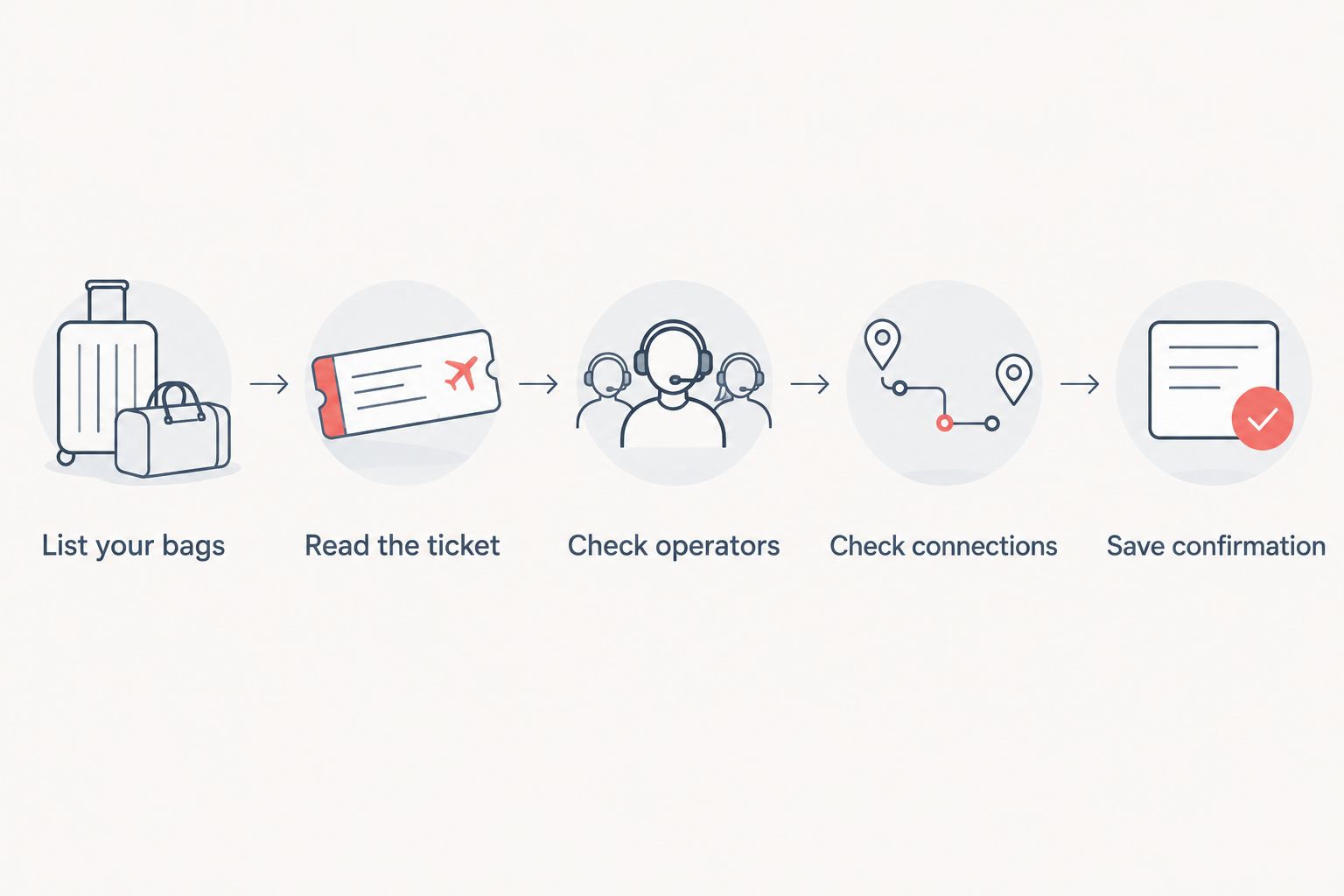
Ask Mann Travel AU to confirm these details against the flight options you are considering. Describe anything unusual explicitly: a pram, a musical instrument or sporting equipment needs a more precise question than whether baggage is included.
Check your India flight options
Compare your route and ask for the baggage conditions attached to each ticket.
Separate checked baggage from security rules
A generous checked allowance does not change Australian international-departure security rules. For liquids, aerosols and gels in cabin baggage, containers generally must hold 100 mL or less and fit within a transparent resealable bag of 1 litre capacity; exemptions have separate conditions.
These are Australian Government Home Affairs security requirements, not airline baggage benefits. Check the current guidance for your 2026 departure, especially if you carry medicines or supplies for an infant.
Also distinguish your total checked allowance from a suitcase handling limit. Singapore Airlines and Emirates specify 32 kg as the maximum weight for an individual checked bag; that ceiling is not a promise that your fare includes that weight.
Which airline should you choose?
Start with Singapore Airlines if weight-based packing flexibility is your main concern. Compare Air India next if a non-stop journey serves your cities; assess Emirates or Malaysia Airlines when Dubai or Kuala Lumpur provides the itinerary you want.
The best decision in 2026 is the ticket that fits your bags throughout the journey. Ask Mann Travel AU for the relevant baggage conditions before committing, and compare the return journey as carefully as the outbound flight.
FAQ
What’s the best airline for baggage allowance on India flights?
Singapore Airlines is the best starting point for travellers prioritising weight-based checked-bag flexibility on Australia–India journeys. The final choice depends on the entitlement attached to your fare and any connecting flights.
Does Air India always include more baggage than Singapore Airlines?
No universal airline-wide comparison answers that question. Compare the exact fares, routes and baggage conditions rather than assuming one airline always includes more.
Can I split a weight-based allowance across different suitcases?
A weight-based allowance generally allows you to distribute the permitted total across bags, subject to the airline’s conditions. Each bag must still meet individual weight and size limits.
Will my international baggage allowance cover a domestic flight in India?
Do not assume your international allowance covers an Indian domestic flight. Confirm the allowance for the domestic sector, especially if it is on a separate ticket.
Does a codeshare flight use the baggage rules of the airline I booked?
Do not assume the selling airline’s standard rules apply to every codeshare sector. Check the baggage conditions on your ticket and confirm cabin restrictions with the operating airline.
Can I put my entire allowance into one heavy suitcase?
Only if that suitcase meets the airline’s individual-bag weight and size restrictions. A total allowance does not override the maximum permitted weight for a single bag.
Should I choose a flight only because it includes more baggage?
No. Choose a ticket that covers your actual luggage and has suitable connections, onward-flight conditions and cabin rules. Extra entitlement has little practical value if another part of the journey restricts your bags.
One last thing
The flight home deserves its own baggage check. Gifts and shopping change what you carry, while the return itinerary can involve different operators or connections. Save the return-flight conditions before departure, not when you are packing in India.
Related guides
- Best airlines for families flying to India
- Best airlines for Melbourne to Amritsar flights
- Best airlines for Sydney to Delhi flights
- Best airlines for Melbourne to Mumbai flights

