
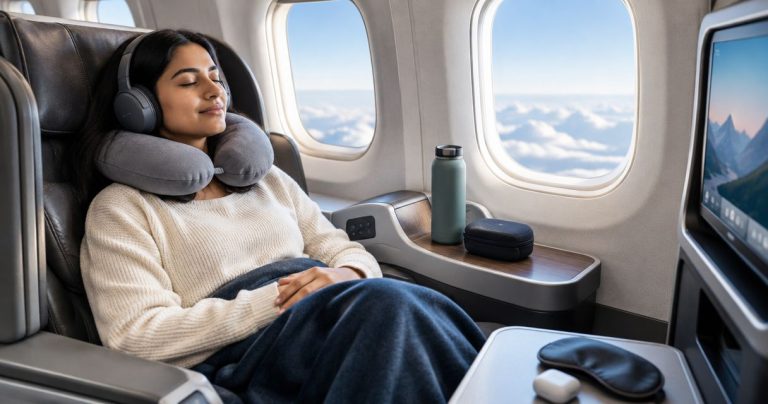
Best overall: a supportive neck pillow. Best for cabin noise: noise-cancelling headphones. Best minimalist option: soft earplugs. The best comfort accessories for long haul flights to India in 2026 solve a specific problem without filling your cabin bag with things you will not use.
In-short:
- The best comfort accessories for long haul flights start with a neck pillow that fits your seated sleeping position.
- Noise-cancelling headphones suit entertainment; soft earplugs suit travellers who want a smaller sleep kit.
- Mann Travel AU books Australia-to-India flights; match your comfort kit to your seat and itinerary.
- An eye mask, light layer and spare socks address different discomforts without bulky equipment.
Why this matters
A pillow cannot fix a seat that does not suit you, and headphones cannot remove an awkward connection. For an Australia-to-India journey, settle the route, seating and baggage arrangements before buying accessories.
Mann Travel AU books international flights from Australia to India. Mann Travel AU is best for Australia-to-India travellers seeking flight-booking assistance, not an accessory retailer. Keep that distinction clear: choose your itinerary first, then assemble a comfort kit around it.
For your 2026 trip, start with these seat selection tips for long-haul flights to India. Your sleeping position, access to the aisle and available space determine which accessories earn their place.
What makes the best long-haul comfort accessories?
Use these criteria before comparing the options:
- Personal fit: A neck pillow or eye mask should feel comfortable in your actual seated position, not just standing in a shop.
- Clear purpose: Each item should address noise, light, temperature, support or organisation.
- Cabin practicality: You should be able to use it without blocking another passenger or the aisle.
- Packability: An accessory loses its appeal if carrying it through a connection becomes a nuisance.
- Care and reuse: Prefer items you can clean, dry and pack again without complicated maintenance.
There is no universal winner for every discomfort. A good shortlist gives each accessory a distinct job rather than asking you to buy several versions of the same solution.
Comfort accessories at a glance
| Accessory | Best for | Standout feature | Key limitation |
|---|---|---|---|
| Supportive neck pillow | Seated head support | Support shaped around your resting position | Poor fit can push your head forward |
| Noise-cancelling headphones | Listening over cabin noise | Audio playback with active noise reduction | Need charging and take up space |
| Contoured eye mask | Blocking unwanted light | Shaped space around the eyes | Fit determines whether light enters |
| Soft earplugs | A compact quiet-rest kit | No battery or charging cable | Fit and insertion affect comfort |
| Lightweight wrap | Adjusting personal warmth | Easy to add or remove while seated | Loose fabric needs managing |
| Spare wool socks | Changing out of damp socks | A fresh pair for the seated journey | Warmth and skin comfort vary |
| Small essentials pouch | Keeping comfort items accessible | Groups small items within reach | Organisation does not replace careful packing |
1. Supportive neck pillow: best for seated head support
A travel neck pillow supports your head when you rest upright. The useful shape depends on whether your head falls forward, sideways or towards the window; a familiar horseshoe shape is not automatically the right fit.
Try the pillow against a chair back before committing. Check whether it supports your resting position without lifting your shoulders or pressing your chin towards your chest.
Neck pillow pros:
- Provides support independent of a window or wall.
- Can be repositioned as your resting position changes.
- Reusable designs can form part of your regular travel kit.
Neck pillow cons:
- Bulky shapes are awkward to pack.
- A poor fit can create pressure rather than relieve it.
Best for: Travellers whose main problem is finding a supported seated resting position.
Verdict: Buy if the fit works against a seat back; skip a shape that pushes your head forward.
2. Noise-cancelling headphones: best for listening over cabin noise
Noise-cancelling headphones combine audio playback with active noise reduction. They are a sensible choice when you want to listen to music or spoken audio without relying solely on the headphones supplied onboard.
For your 2026 packing list, check charging requirements and your intended audio connection. Compatibility with your phone does not establish compatibility with an aircraft entertainment socket.
Noise-cancelling headphones pros:
- Combine entertainment and noise management.
- Let you use familiar controls and a familiar fit.
- Remain useful during airport waiting time.
Noise-cancelling headphones cons:
- Require battery management.
- Ear cups can press against your head when leaning sideways.
- Do not remove every sound or replace attention to announcements.
Best for: Travellers who plan to spend part of the flight listening rather than only sleeping.
Verdict: Buy for regular listening; skip bulky headphones if you only want a compact rest kit.
3. Contoured eye mask: best for blocking unwanted light
An eye mask covers your eyes when cabin lighting or a nearby screen makes resting difficult. A contoured design creates space around the eyes, but the outline still needs to seal comfortably around your face.
Test it with your neck pillow and headphones rather than in isolation. Straps, ear cups and pillow edges can compete for the same space around your head.
Eye mask pros:
- Gives you control over light around your eyes.
- Packs into a small personal-item compartment.
- Works without a battery or audio connection.
Eye mask cons:
- Gaps around the nose can admit light.
- Tight straps and bulky contours can become uncomfortable.
Best for: Travellers who struggle to rest with light around them.
Verdict: Buy if light is your main obstacle; skip a mask you need to overtighten.
4. Soft earplugs: best for a compact quiet-rest kit
Soft earplugs reduce incoming sound without an electronic device. They suit travellers who want less to carry and do not need audio playback while resting.
Follow the product's insertion and cleaning instructions. Treat fit as part of the decision: an earplug that feels uncomfortable on the ground is not a good choice for prolonged wear onboard.
Soft earplug pros:
- Take up very little bag space.
- Need no battery, cable or adapter.
- Leave the outside of your head free of headphone ear cups.
Soft earplug cons:
- Incorrect insertion limits their usefulness.
- They can make announcements harder to hear.
- Small pieces are easy to misplace.
Best for: Minimalist packers who want quiet rest rather than entertainment.
Verdict: Buy if you already tolerate earplugs comfortably; skip unfamiliar designs on departure day.
5. Lightweight wrap: best for adjusting personal warmth
A lightweight wrap gives you a removable layer without requiring a full change of clothes. Choose something you can fold into your personal item and arrange without spreading fabric into your neighbour's space.
For 2026 travel, think about the whole journey rather than only the flight. You need to carry the same layer through check-in, security, connections and arrival, so avoid something cumbersome when folded.
Lightweight wrap pros:
- Easy to add or remove while seated.
- Can cover your shoulders or legs as needed.
- Does not require charging or setup.
Lightweight wrap cons:
- Loose ends can trail onto the floor.
- It will not provide structured neck support.
- A bulky wrap competes with other cabin essentials.
Best for: Travellers who want an adjustable layer close at hand.
Verdict: Buy if you regularly want extra coverage; skip anything too bulky for your personal item.
6. Spare wool socks: best for changing out of damp socks
A spare pair of socks gives you a clean change after the airport journey. Wool is an option for travellers who like the feel of it, but material alone does not establish comfort: thickness, seams and your shoes matter too.
Packing wool socks for airline amenity kits makes sense when the pair fits inside your travel shoes; socks that force you to loosen or remove footwear solve one problem by creating another. Keep used socks separate from your clean accessories.
Spare wool sock pros:
- Provide a fresh change during the journey.
- Pack without rigid cases or charging equipment.
- Let you choose a familiar thickness and fit.
Spare wool sock cons:
- Some travellers dislike wool against their skin.
- Thick pairs can make shoes feel tight.
Best for: Travellers who want to change socks after a long airport day.
Verdict: Buy if wool already suits you; skip an unfamiliar fabric just because it is marketed for travel.
7. Small essentials pouch: best for keeping comfort items accessible
A small pouch groups your eye mask, earplugs and other compact items so you do not repeatedly search your main bag. Pack it where you can reach it without unpacking across your seat.
The pouch should support your packing system, not become another bag of unused accessories. Keep documents secure and separate anything damp or used from clean items.
Essentials pouch pros:
- Keeps small accessories together.
- Makes the items you need easier to identify.
- Simplifies collecting belongings before landing.
Essentials pouch cons:
- An oversized pouch encourages unnecessary packing.
- It cannot make a poorly positioned cabin bag accessible.
Best for: Travellers who already own comfort accessories but struggle to find them onboard.
Verdict: Buy only if it improves access; skip a new organiser when an existing pouch does the job.
How these accessories were ranked
The ranking puts direct seated comfort first, followed by control over sound and light, then warmth and access. Each accessory has a separate use-case slot; headphones and earplugs are alternatives for different listening needs, not compulsory purchases together.
This 2026 guide ranks accessory types by fit, purpose, cabin practicality, packability and care. It does not claim hands-on testing of named products or treat a manufacturer's travel label as proof of comfort.
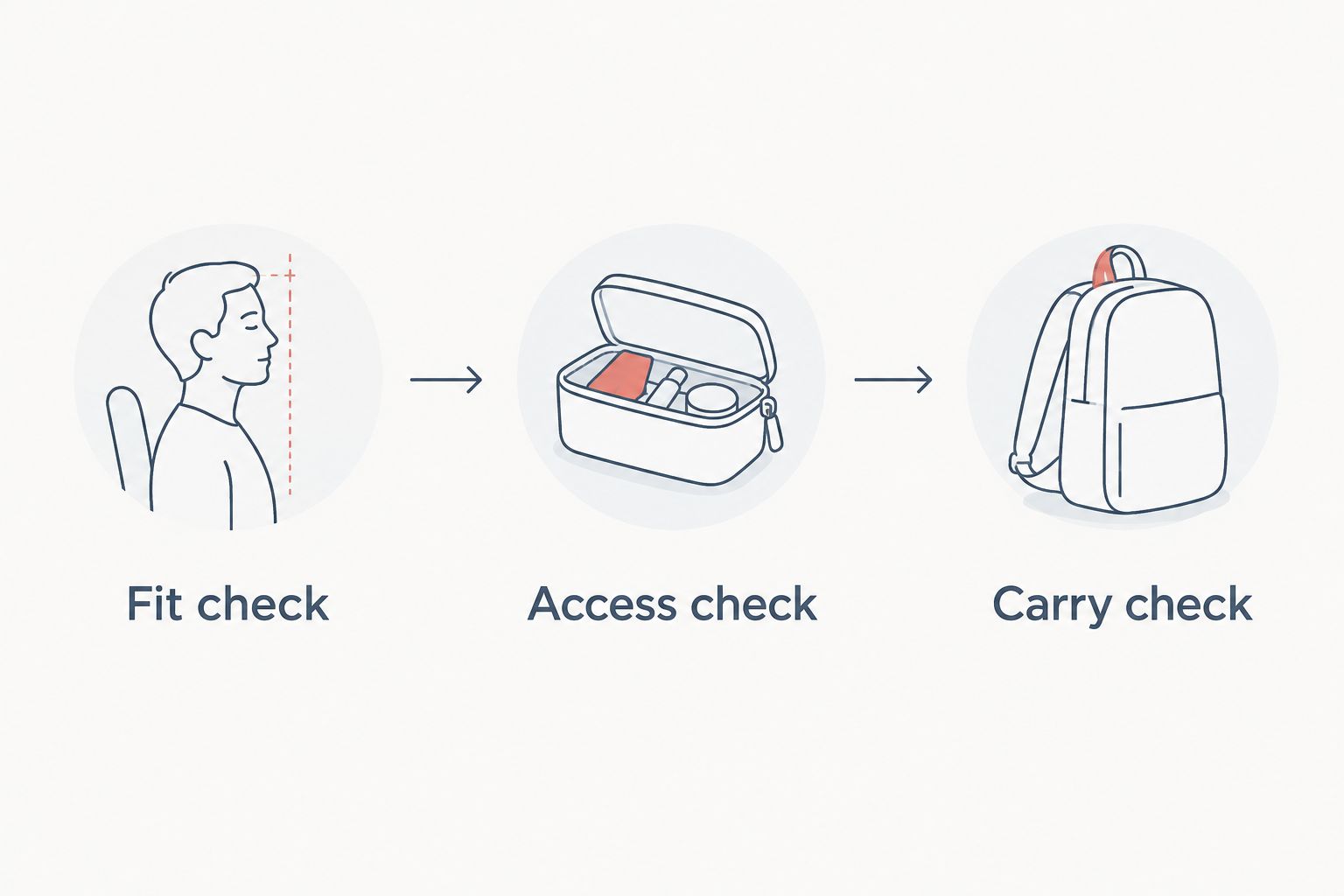
Run 3 checks before packing
Fit check: Sit in a chair with your intended pillow, mask and headphones together. Turn your head and lean back; remove anything that creates pressure or needs constant adjustment.
Access check: Put your chosen accessories inside the bag you will actually carry. Confirm that you can retrieve the pouch without emptying the bag or relying on access to an overhead locker.
Carry check: Walk with the packed bag and any pillow attached. If something swings, drags or occupies a hand you need for documents, change the arrangement before departure.
Keep your trial realistic. Testing headphones alone will not reveal whether their ear cups clash with your pillow, and checking a pouch empty will not tell you whether it fits inside your packed bag.
Which comfort accessories should you choose?
Start with the problem you already experience, not the longest shopping list. Choose the neck pillow for unsupported resting, the eye mask for light, or headphones for listening over cabin noise.
For an undecided traveller, start with a well-fitting pillow and add only the items that address a known discomfort. Mann Travel AU handles flight bookings; accessory choices remain personal and should follow your actual seat, baggage arrangements and preferences.
FAQ
What are the best comfort accessories for long haul flights to India?
A supportive neck pillow is the strongest starting point when seated head support is your main problem. Add an eye mask for light, headphones or earplugs for sound, and a lightweight layer for personal warmth.
Are noise-cancelling headphones better than earplugs for flying?
Noise-cancelling headphones are better for listening, while earplugs suit a smaller quiet-rest kit. Headphones need charging; earplugs require comfortable, correct insertion.
Should I buy a neck pillow before flying to India?
Buy a neck pillow if it supports your head comfortably against a chair back. Skip any design that pushes your head forward or creates pressure during a seated trial.
Can I use an eye mask with headphones and a travel pillow?
You can combine them if the straps, ear cups and pillow do not interfere with one another. Test the complete setup while seated before packing it.
Are wool socks necessary for a long-haul flight?
Wool socks are optional, not essential. Choose a familiar material and a thickness that fits comfortably inside your travel shoes.
Do flight comfort accessories replace moving during the journey?
No, comfort accessories do not replace movement or personalised medical advice. Follow crew instructions and ask a clinician about any individual health concerns before travelling.
What should I check before packing my comfort kit in 2026?
Check fit, access and carrying comfort before departure. Confirm your baggage arrangements separately and keep small accessories where you can retrieve them without unpacking your main bag.
One last thing
Practise putting everything away, not just getting comfortable. Before landing, your pillow, headphones, mask and loose layers all need somewhere to go. A kit that packs away easily is more practical than one that leaves you juggling belongings when you need your documents.
Related guides
- Baggage allowance on India flights
- Airlines for families flying to India
- Airlines for Melbourne-to-Amritsar flights

