

Best overall for a suitable nonstop journey: Air India. Best for a Singapore connection: Singapore Airlines. Best budget choice: the itinerary with the lowest total cost after baggage and fare conditions—not a fixed airline winner. This guide compares the best airlines for students flying to India in 2026 by route, luggage and flexibility.
In-short:
- Air India is the best starting point for students whose Australian departure and Indian destination fit a nonstop service.
- Compare Singapore Airlines, Malaysia Airlines and Cathay Pacific by connection quality, baggage and ticket conditions.
- The best airlines for students flying to India depend on your destination and return-date certainty.
- Mann Travel AU books Australia-to-India flights; request an itinerary comparison that includes baggage and change conditions.
Why this matters
A student booking is not automatically the right booking. A baggage benefit has little value if the itinerary needs a separate domestic ticket, while a restrictive return fare becomes a problem when your university timetable changes.
Choose the complete journey, not the student label. Start with your Australian departure city, final Indian destination and the luggage you will actually carry. Mann Travel AU books international flights from Australia to India, so you can ask for alternatives against the same travel requirements.
Mann Travel AU is best for students seeking agency help comparing Australia-to-India flight bookings. Keep the comparison practical: exact airports, onward travel, baggage and what happens if you change your return.
What makes the best airline for student travel?
Use these criteria before choosing an airline for your 2026 trip:
- Route fit: Prefer an itinerary that gets you close to your actual destination without unnecessary airport changes or separate tickets.
- Baggage fit: Check checked and cabin baggage on every flight, including any domestic connection. Do not assume a student offer applies.
- Change conditions: Read the change fee, fare-difference requirement, cancellation conditions and no-show rules for the quoted ticket.
- Connection quality: Compare the transit airport, connection length, overnight timing and any entry or transit requirements.
- Total journey cost: Include baggage, airport transfers and onward transport rather than comparing the headline fare alone.
- Eligibility clarity: If requesting a student fare, confirm the documents and restrictions attached to that specific offer before booking.
There is no reliable airline-wide winner for every student. Your itinerary and fare conditions decide which option belongs first.
Student airlines at a glance
The ranking below assigns each airline a different use case. It does not rank current fares or promise student benefits.
| Airline | Best for | Standout route feature | Key limitation |
|---|---|---|---|
| Air India | A suitable nonstop journey | Australia–India nonstop routes where your cities match | A nonstop arrival city might still leave you with onward travel |
| Singapore Airlines | A connection through Singapore | Singapore hub connecting Australian and Indian cities | Adds a connection compared with a suitable nonstop flight |
| Malaysia Airlines | Comparing a Kuala Lumpur connection | Kuala Lumpur hub for connecting journeys | Must be assessed on the exact route and fare, not assumed cheapest |
| Cathay Pacific | A connection through Hong Kong | Hong Kong hub for onward travel to India | Transit routing can add travel compared with a suitable nonstop option |
| Emirates | A planned Dubai stopover | Dubai hub linking Australian and Indian cities | Routing through Dubai adds distance on many Australia–India journeys |
1. Air India: best student airline for a suitable nonstop journey
Air India is the first airline to compare when its Australia–India nonstop routes match your journey. Removing a transit stop removes a connection you would otherwise need to manage, which is useful when travelling with luggage or arriving before a fixed commitment.
The important word is suitable. A nonstop flight into one Indian city is not automatically better than a through-ticket connection into the city where you need to be.
Air India pros:
- A suitable nonstop itinerary avoids changing aircraft at an overseas hub.
- Fewer flight sectors mean fewer boarding and transfer steps.
- An Indian arrival point can suit students continuing to family or university by ground transport.
Air India cons:
- Its nonstop routes do not match every Australian departure and Indian destination.
- A separate onward flight introduces another ticket's baggage and change conditions.
- Student status alone does not establish the allowance or flexibility of your ticket.
Best for: Students whose departure airport and Indian destination fit a nonstop service.
For your 2026 comparison, put the nonstop itinerary beside the best through-ticket alternative. Compare arrival at your final destination, not just touchdown in India. If onward travel cancels out the simplicity, move to the connecting options.
Verdict: Buy when the nonstop route fits your complete journey and the fare conditions fit your plans.
2. Singapore Airlines: best for connecting through Singapore
Singapore Airlines connects Australian and Indian destinations through Singapore. It is a useful comparison when a nonstop route does not serve your final destination or when you want to assess a Singapore transit against other hubs.
Judge the actual connection rather than the airline name. A shorter flight combination is not useful if the transfer creates an uncomfortable rush or the arrival time complicates your onward journey.
Singapore Airlines pros:
- Singapore provides a connecting hub between Australia and India.
- A through-ticket itinerary gives you a single booking to assess rather than assembling separate tickets.
- It offers a distinct routing alternative to connections through Kuala Lumpur, Hong Kong or Dubai.
Singapore Airlines cons:
- A connection adds another departure and boarding process.
- A long transit extends the journey even when both flight sectors suit you.
- Baggage and change conditions still depend on the ticket you select.
Best for: Students whose complete itinerary works well through Singapore.
Ask whether luggage is checked through and whether the connection is included on the same ticket. Confirm these details for the actual booking, particularly if another airline operates any sector.
Verdict: Buy when the Singapore connection gives you a workable through-ticket journey to your final Indian city.
3. Malaysia Airlines: best for comparing a Kuala Lumpur connection
Malaysia Airlines connects journeys through Kuala Lumpur. Include it when you want another routing to compare against Singapore or a nonstop option, without assuming it will be the lowest-cost choice.
For students, its place on the shortlist depends on the complete quote. Compare the baggage you need and the conditions you can accept before treating any difference in the headline fare as a saving.
Malaysia Airlines pros:
- Kuala Lumpur offers another connecting hub to assess.
- A suitable through-ticket itinerary avoids building the journey from unrelated bookings.
- The routing gives you an alternative when another hub's timings do not suit your plans.
Malaysia Airlines cons:
- It is not automatically the budget winner for your dates.
- Transit time can outweigh a useful departure time.
- Separate onward arrangements still require their own baggage and disruption checks.
Best for: Students comparing a Kuala Lumpur itinerary against other connections.
For a 2026 booking, request equivalent comparisons: the same destination, similar dates and the same luggage requirement. Comparing a baggage-inclusive ticket with a ticket that excludes what you need produces a misleading result.
Verdict: Buy when the Kuala Lumpur itinerary wins on your total journey requirements, not its reputation for value.
4. Cathay Pacific: best for connecting through Hong Kong
Cathay Pacific connects Australian and Indian destinations through Hong Kong. Consider it when that routing produces a useful departure, connection and arrival combination for your particular cities.
Do not reject or select it based only on a map. Examine the full itinerary, including how the arrival time fits your final transfer in India.
Cathay Pacific pros:
- Hong Kong provides a different hub option for your comparison.
- A suitable connecting itinerary can take you beyond the Indian cities served by your nonstop alternatives.
- It gives you another schedule to assess when your dates are fixed.
Cathay Pacific cons:
- The route adds a connection compared with a suitable nonstop service.
- Routing through Hong Kong is not the most direct geographical choice for every city pair.
- An inconvenient transit can erase the benefit of a suitable departure time.
Best for: Students whose dates and destination fit a Hong Kong connection.
Check the date attached to every arrival and departure. Overnight travel and local time differences make a quick glance at clock times an unreliable way to judge a connection.
Verdict: Buy when the Hong Kong itinerary fits your dates and onward travel better than the alternatives.
5. Emirates: best for a planned Dubai stopover
Emirates connects Australian and Indian cities through Dubai. It belongs on a student shortlist when Dubai is an intentional part of the journey, rather than an extra stop accepted without checking the total travel involved.
A stopover is a separate planning decision from a simple airport transit. Check entry requirements, accommodation and airport transfers before committing to time outside the airport.
Emirates pros:
- Dubai provides a connecting hub serving Australian and Indian cities.
- The routing suits a journey that intentionally includes Dubai.
- It offers another itinerary to compare when your departure and arrival dates are fixed.
Emirates cons:
- Routing through Dubai adds distance on many Australia–India journeys.
- A stopover adds accommodation and transfer arrangements.
- Student benefits must be confirmed for the specific booking rather than assumed.
Best for: Students who deliberately want to include Dubai in their travel plans.
If your only goal is to reach India with fewer travel steps, compare suitable nonstop and shorter connecting routes first. A planned stopover and an unwanted long transit are not the same thing.
Verdict: Buy for an intentional Dubai stopover; skip when the detour does not serve your plans.
How this ranking works
This 2026 ranking prioritises route fit, baggage, ticket conditions and connections. Air India takes the default position only for a suitable nonstop journey; the remaining airlines each represent a different connecting hub or stopover purpose.
No position establishes a current fare advantage, a student baggage entitlement or a service-quality score. Move an airline up your personal shortlist when its specific itinerary better matches the criteria above.
Check the ticket before you book
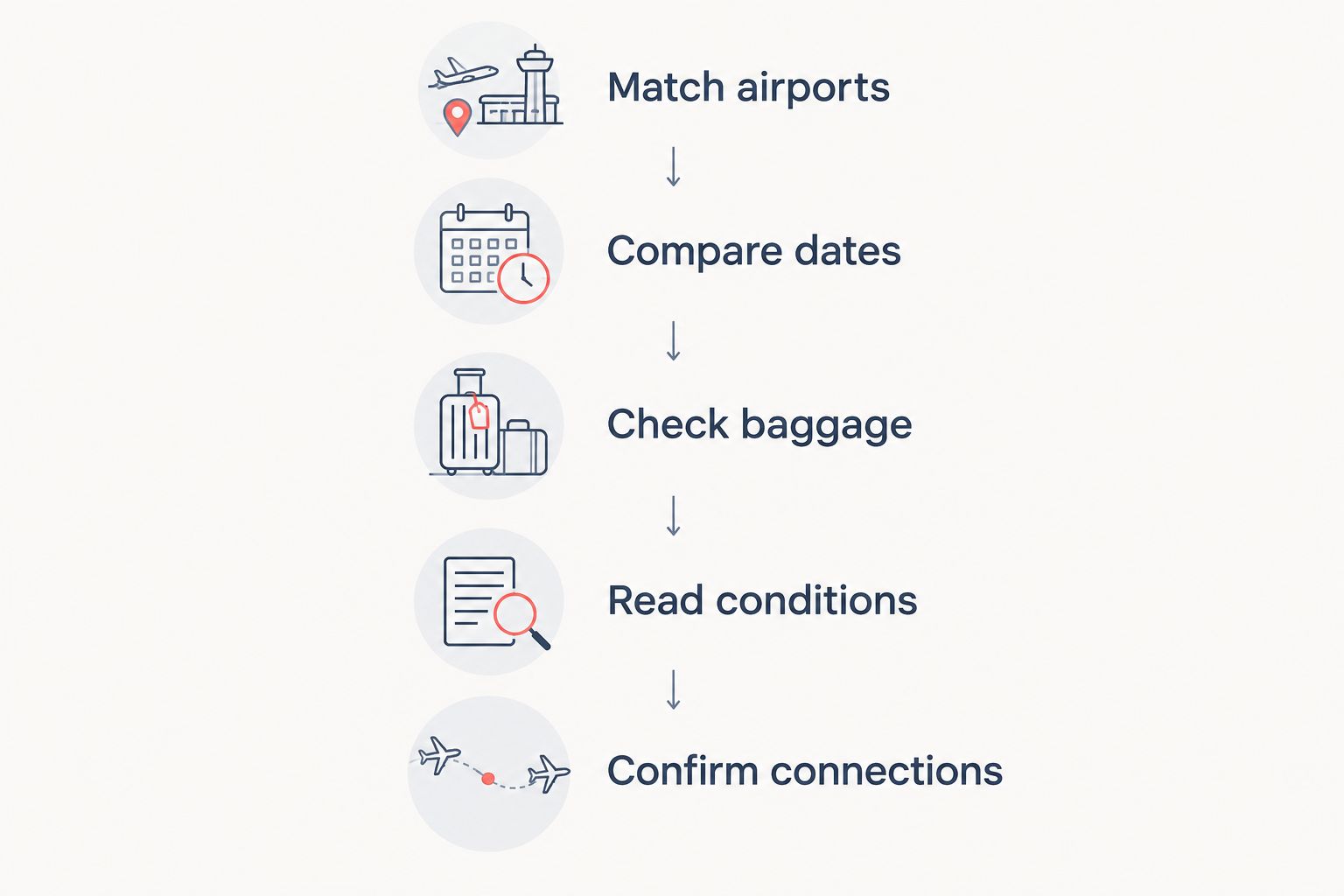
Use this sequence to turn a shortlist into a booking decision:
- Match airports: Write down your Australian departure airport and final Indian destination, including any onward journey.
- Compare dates: If your timetable allows, compare 2 departure dates and 2 return dates using the same baggage requirement.
- Check baggage: Confirm cabin and checked allowances for every sector, plus any separate domestic ticket.
- Read conditions: Check changes, fare differences, cancellations and missed-departure conditions before paying.
- Confirm connections: Ask whether all sectors sit on 1 booking and confirm the ticketing and transfer arrangements.
Keep the written quote and fare conditions with your itinerary. A verbal description such as flexible does not replace the rules attached to the ticket.
For student offers, ask which documents are required and when they must be supplied. Also check whether the offer applies to your route and travel dates; an advertised student programme is not proof that your ticket includes its benefits.
Compare your student flight options
Ask Mann Travel AU to compare Australia-to-India routes, baggage and ticket conditions.
Which airline should you choose?
Start with Air India if a nonstop service fits your actual journey. Otherwise, compare Singapore Airlines, Malaysia Airlines and Cathay Pacific against the same destination, baggage and change requirements. Include Emirates when Dubai is a deliberate part of the trip.
For your 2026 booking, choose the itinerary you can use without relying on an unconfirmed allowance or an uncertain onward transfer. If your return date is unsettled, read the change conditions before deciding which quote represents value.
FAQ
What’s the best airline for students flying from Australia to India?
Air India is the best starting point when a nonstop route fits your departure and final destination. Compare connecting airlines when they provide a better complete journey, baggage fit or ticket conditions.
Is a student fare always the cheapest way to fly to India?
No. Compare the complete student and standard fare quotes, including the luggage you need and the applicable change conditions. A student label alone does not establish better value.
Do students automatically get extra baggage on flights to India?
No. Extra baggage must be included in the conditions of your specific booking. Confirm eligibility, required documents and allowances for every flight sector before paying.
Is Air India better than Singapore Airlines for students?
Air India is the stronger starting point for a suitable nonstop journey; Singapore Airlines is an option for connecting through Singapore. Your final destination and ticket conditions determine the better fit.
Can I change my return flight after booking?
Your ticket’s fare conditions determine whether you can change the return flight and what charges apply. Check both the change fee and any fare difference before booking.
Should I book a separate domestic flight after arriving in India?
Compare a separate domestic booking with a through-ticket itinerary before deciding. Separate tickets require their own baggage, check-in and missed-connection planning.
Can Mann Travel AU help with student flights to India?
Mann Travel AU books Australia-to-India international flights. Ask for a comparison based on your student eligibility, destination, luggage and return-date requirements, with the applicable conditions confirmed before booking.
One last thing
Check the return journey as carefully as the outbound flight. A booking that gets you to India conveniently can still leave you with an awkward return connection or unsuitable change conditions. Read both directions before approving the itinerary.
Related guides
- Best airlines for Melbourne to Amritsar flights
- Best airlines for Sydney to Delhi flights
- Best airlines for Melbourne to Mumbai flights
- Best airlines for Brisbane to Delhi flights

