

Instead of manually converting every Australia-to-India flight quote, compare the final payment currency with your card’s billing currency and check who performs any conversion before you authorise payment. Choose AUD or INR only after checking the complete transaction, not just the currency shown beside the flight.
In-short:
- For the search ‘pay in aud or inr india flights’, compare settlement currency, conversion and card fees before paying.
- AUD suits AUD-funded payments without conversion; INR suits INR-funded payments when the seller accepts them.
- Mann Travel AU suits Australia-to-India travellers seeking agency booking assistance; confirm accepted payment currencies before proceeding.
- A converted AUD offer is not the same as an original AUD quote.
Why this matters
Your search currency, the currency charged by the seller and your account currency are separate things. An AUD display does not establish that the final card transaction will be submitted in AUD.
For your 2026 booking, separate the flight decision from the payment decision. First confirm the itinerary and fare conditions; then check the payment route without changing those flight details.
Mann Travel AU is best for Australia-to-India travellers who want agency help with their flight booking. You can ask Mann Travel AU about your itinerary, but confirm the accepted currency and payment method before authorising a transaction. Agency assistance does not replace checking your own bank’s terms.
Before you start
- Prepare your booking details: passenger names as shown on passports, travel dates, departure and arrival airports, baggage requirements and the itinerary you want to purchase.
- Check your payment access: have the account or card you intend to use, its current fee schedule and access to the bank’s transaction-authentication method.
- Catch the hidden currency change: a seller’s AUD quote and an offer to convert an INR transaction into AUD are different payment arrangements. Read the final currency and conversion disclosure before confirming.
Keep another person’s payment separate from passenger identity. If a family member in India will pay, ask the seller about third-party payment requirements before sending payment instructions or card details.
Payment currency configuration
Establish the original quote
- Fix the itinerary. Keep the same flights, travel dates, cabin, baggage and fare conditions throughout the comparison. Otherwise, a different total might reflect a different ticket rather than a currency difference.
- Record the quoted currency. Look for AUD or INR, not a currency symbol alone. Ask the seller to confirm the transaction currency when the quote does not make it explicit.
- Confirm the accepted method. Ask whether the intended card or account can pay in that currency. Do not assume that a currency shown during browsing is supported at payment.
- Check the final summary. Before authorising anything, compare the itinerary and currency with your original quote. Stop if either has changed without explanation.
Expected result: you know which flight you are purchasing and which currency the seller intends to charge. No conversion decision has been left to an assumption.
For a 2026 booking handled by an agent, request the same information in writing. A useful request is: please confirm the transaction currency, accepted payment method, seller-imposed payment fees and whether any conversion will be offered before payment.
Match the funding account
- Identify the funding currency. Check whether the money will come from an AUD balance, an INR balance or another currency balance. A card’s issuing country alone does not establish which balance funds the transaction.
- Read the issuer’s terms. Check foreign-currency conversion, international transaction fees and any conditions applying to the intended payment. These charges are separate from the seller’s own charges.
- Compare the payment paths. Use the table below to distinguish a direct currency match from a converted transaction. Treat it as a decision aid, not a claim that every seller supports every path.
- Choose the clearest supported route. Prefer a route whose currency, conversion responsibility and charges you can identify before payment. Do not choose solely because an AUD figure feels more familiar.
| Payment path | Best for | Main advantage | Main drawback | Check before paying |
|---|---|---|---|---|
| Original AUD quote paid from AUD funds | Travellers funding the booking in Australian dollars | Avoids a currency mismatch between the charge and funding balance | International transaction fees can still depend on issuer terms | Whether the issuer treats the transaction as international |
| Original INR quote paid from INR funds | Travellers or family members funding the booking in rupees | Avoids a currency mismatch when the intended INR balance is used | Seller acceptance and third-party payer checks still apply | Accepted payment method and payer requirements |
| Original INR quote paid from AUD funds | Travellers using an AUD-funded card for an INR charge | Keeps the transaction in the seller’s original quoted currency | Requires conversion under the applicable card or account terms | Conversion method and issuer fees |
| INR transaction converted to AUD at payment | Travellers considering a checkout conversion offer | Shows the proposed converted AUD amount before authorisation | Uses the conversion provider’s terms rather than simply preserving the INR charge | Disclosed exchange rate, charges and consent |
Expected result: you have identified the funding account and know whether the transaction requires conversion. Matching currencies removes that particular conversion; it does not establish that the whole payment is fee-free.
Conversion and authorisation checks
- Identify the converter. If the original charge is in INR and your funding balance is AUD, establish whether conversion will happen through your card arrangements or through a conversion offer at payment.
- Read the conversion offer. Dynamic currency conversion, often called DCC, lets a participating merchant or payment provider offer a transaction in the cardholder’s home currency. Review its disclosed rate and charges rather than assuming it improves the payment.
- Keep your chosen currency. If you want the original INR charge, select INR where that choice is offered. If you accept a converted AUD transaction, retain the conversion disclosure with your receipt.
- Authorise once. Complete the bank’s authentication request and wait for a clear outcome. Check the booking status before attempting another payment after an interruption.
- Verify the outcome. Check the seller’s confirmation and your bank’s transaction details. A payment receipt alone is not the same document as an issued flight ticket.
Expected result: you know which currency you authorised, who handled conversion and whether the flight has been ticketed. You also have the evidence needed to investigate a mismatch.
Use this sequence for your 2026 payment check: original quote, funding account, conversion choice, payment confirmation. It works whether you book directly with a seller or receive payment instructions from an agent.
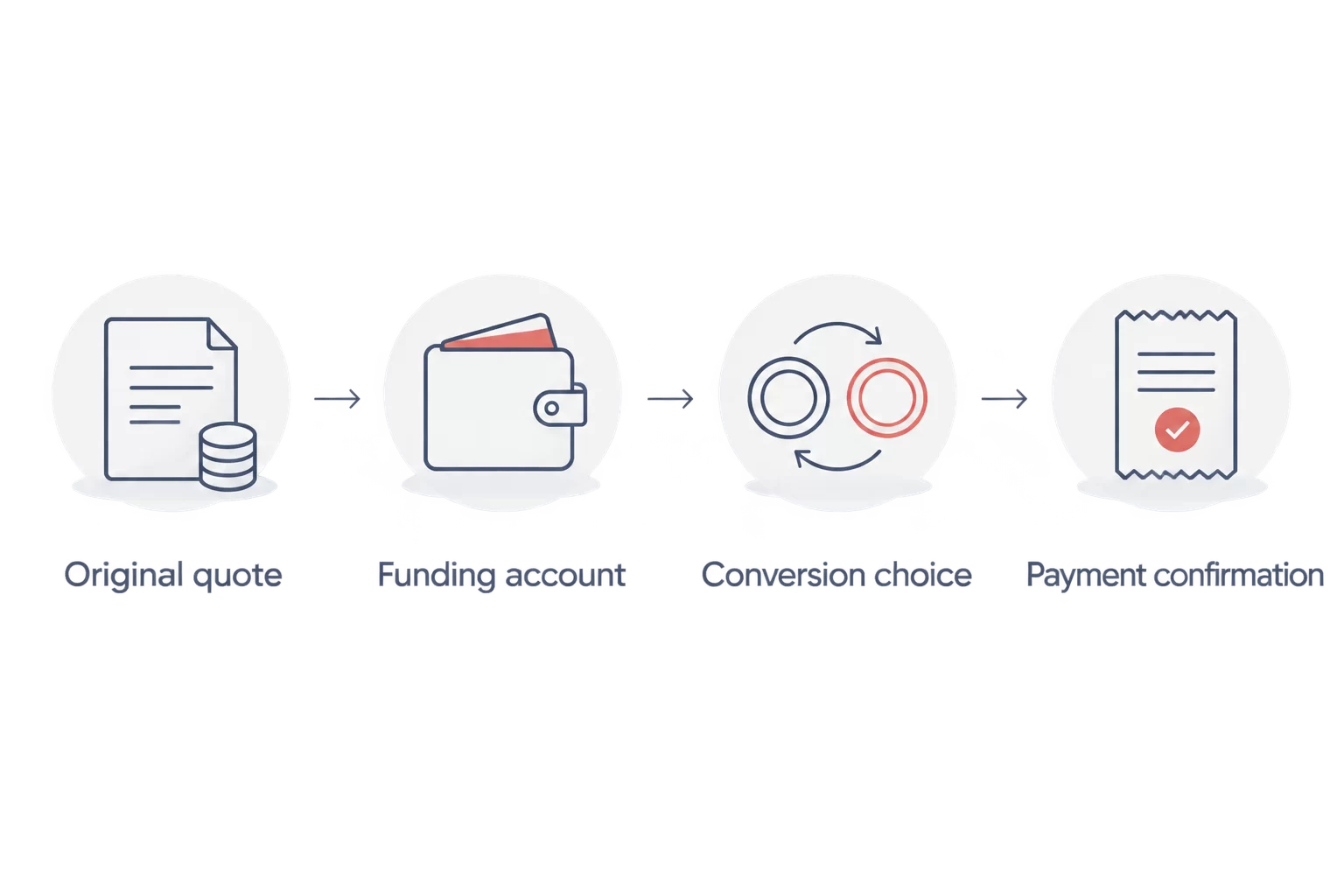
The currency codes matter more than the symbols. An AUD amount on a comparison screen and an AUD amount produced by checkout conversion describe different stages of the transaction, even when both use the Australian dollar symbol.
When a family member in India pays instead
An INR-funded payment is a separate workflow, not simply a currency switch on your Australian card. Confirm that the seller accepts the payer’s intended method and permits payment for another traveller.
- Keep the passenger details unchanged. The traveller’s name must remain the passenger name; do not replace it with the payer’s name.
- Confirm payer requirements. Ask what verification or authorisation the seller requires from someone paying for another person. Follow the seller’s approved process rather than emailing card details.
- Confirm the charge currency. An Indian-issued card does not by itself prove that the seller will submit an INR transaction. Obtain explicit confirmation.
- Assign the communications. Decide who receives the payment receipt and who receives the itinerary and ticket documents. Ensure the traveller can access the booking information.
- Check the refund route. Ask how refunds are processed before payment, including what happens if the original payer’s account changes.
Expected result: the traveller, payer and seller agree on the passenger identity, transaction currency and document delivery. Paying from India should not leave the traveller without access to the booking.
For family travel in 2026, make the payer arrangement clear before anyone authorises a charge. Avoid simultaneous payment attempts from Australia and India against the same booking.
Troubleshooting payment problems
The checkout shows AUD after an INR quote
Check whether you are seeing a display conversion, a new quote or an optional payment conversion. Read the final transaction summary and conversion disclosure; do not infer the charge currency from the search screen.
If you cannot establish what will be submitted to the card, stop and ask the seller. An unclear currency is a reason to pause payment, not to guess.
The bank adds a fee to an AUD transaction
Check the issuer’s international transaction terms. Some issuers apply international transaction fees based on the merchant or processing location, even when the transaction is denominated in AUD.
Compare the bank’s transaction entry with the seller’s receipt. Ask the issuer to identify the fee category rather than assuming the seller converted the payment incorrectly.
Authentication fails or the card is declined
Check the authentication request through your bank’s official app or usual verification channel. Then ask the issuer whether the attempted transaction was blocked and confirm the seller’s booking status before retrying.
Do not repeatedly submit the payment while the result is unclear. A fresh attempt does not resolve an earlier pending authorisation.
The bank shows a pending payment but no ticket arrives
Contact the seller with the booking reference and payment details. Ask whether the payment was received and whether the ticket has been issued; these are separate questions.
Avoid creating a replacement booking until the first booking’s status is clear. Share only the information needed to trace the transaction, never your full card credentials.
A refund does not match the original account debit
Compare the refund currency and amount with the original transaction currency and amount. A foreign-currency refund can produce a different home-currency result because the conversion rate and applicable fees can differ.
Ask the seller about the refund submitted and the bank about the account conversion. Those questions establish where a difference arose without treating every mismatch as a ticketing error.
Customise your workflow
Build a reusable payment note for your 2026 travel planning. Keep 3 checks at the top: transaction currency, conversion provider and issuer fees. These checks remain useful when you change travel dates, airports or payer.
Keep 2 records after payment: the seller’s receipt and the issued ticket confirmation. Save them securely alongside the relevant bank transaction entry, and use 1 booking reference when following up about the same reservation.
If you also want to earn card rewards, review the guide to credit cards for earning points on India flights. Assess payment terms separately from rewards; earning points does not establish that a currency conversion is favourable.
For agency-assisted bookings, ask Mann Travel AU to confirm the proposed payment arrangement before you authorise it. Keep your bank’s fee assessment separate from the agency’s booking advice.
Confirm your booking payment details
Ask about the transaction currency and payment process for your Australia-to-India booking.
Frequently Asked Questions
Should I pay in AUD or INR for flights to India?
Choose after checking the original transaction currency, your funding currency and the applicable conversion and payment fees. AUD suits an AUD-funded original AUD charge; INR suits an INR-funded original INR charge when the seller accepts the payment method.
Does an AUD flight quote mean my card will be charged in AUD?
No, an AUD display alone does not establish the final transaction currency. Check the payment summary or ask the seller to confirm the currency that will be submitted to your card.
Is paying in INR always better with an Australian card?
No, an INR transaction funded from AUD requires conversion under the applicable payment terms. Compare those terms with any offered checkout conversion before choosing.
What is dynamic currency conversion when booking a flight?
Dynamic currency conversion is an offer to convert a transaction into the cardholder’s home currency at payment. Review the provider’s disclosed exchange rate and charges before accepting it.
Can my family in India pay for my flight from Australia?
Ask the seller whether it accepts third-party payment through your family member’s intended method. Confirm payer verification, transaction currency and document delivery before payment.
Why did my bank charge a fee when I paid in AUD?
An issuer can apply an international transaction fee to an AUD payment under its account terms. Check the fee category with your bank and compare the entry with the seller’s receipt.
Can Mann Travel AU help me check how to pay for my booking?
Ask Mann Travel AU to confirm the accepted payment method and transaction currency for your proposed booking. Check conversion and account fees separately with your payment provider.
One last thing
Check ticket issuance, not just payment success. Before closing your 2026 booking task, confirm the passenger names, itinerary and issued ticket documents; a familiar currency on a successful payment screen does not verify those details.
Related guides
- Fly now pay later for international students
- Airlines for baggage allowance on India flights
- Flights to India for wedding guests and groups

