

Best overall: a flexible transferable-points card with a confirmed redemption path. Best for an existing balance: a card earning your current airline’s points. Best for occasional travel: a lower-fee rewards card. The best credit cards for flights to India in 2026 depend on which points you can actually use, not which welcome offer looks biggest.
In-short:
- The best credit cards for flights to India match your route, existing points and repayment capacity.
- Choose transferable rewards only after confirming the airline partner, transfer rules and reward-seat access.
- Qantas Points and Velocity Points cards suit travellers building an existing balance, subject to suitable redemptions.
- Mann Travel AU books Australia-to-India flights; card selection remains a separate financial decision.
This guide ranks card structures rather than individual bank offers. Compare current issuer terms before applying; the recommendations below do not rank live welcome bonuses or promise reward seats. For help with the journey itself, Mann Travel AU books international flights from Australia to India.
Why this matters
A credit card earns rewards under the card issuer’s rules. An airline loyalty programme controls how its points are redeemed. Those are separate decisions, and a strong earning offer does not establish that your family can book the flights you need.
For Australia-to-India travel, start with your departure city, Indian destination and travel dates. A useful redemption for Melbourne to Delhi does not automatically solve a Sydney to Kochi trip, particularly when connections or separate tickets enter the picture.
Mann Travel AU is best for Australians seeking agency help booking Australia-to-India flights, not choosing a credit card. Keep the flight-booking decision separate from the borrowing decision, and do not assume an agency booking qualifies for a card’s airline-specific earning category.
What makes the best credit cards for India flights?
Use these criteria before looking at a welcome offer:
- Usable redemption path: Identify a loyalty programme that offers suitable bookings for your intended journey.
- Existing points balance: Check whether the card builds a balance you already hold or creates another disconnected account.
- Everyday earning rules: Read eligible-spend exclusions, earning caps and any reduced earning categories.
- Transfer conditions: Confirm the receiving programme, conversion ratio, minimum transfer and processing conditions.
- Total card cost: Consider annual fees, interest, transaction charges and any card surcharge against benefits you will actually use.
- Repayment fit: Choose rewards only if you can manage the account without carrying debt to earn points.
For your 2026 shortlist, treat an attractive bonus as the final comparison, not the first filter. A card that fails your route or repayment requirements does not become suitable because it offers more points upfront.
Credit card options at a glance
| Rank and card structure | Best for | Standout feature | Key limitation |
|---|---|---|---|
| 1. Flexible transferable-points card | Travellers comparing loyalty programmes | Retains a choice of eligible transfer destinations | Partners and conversion rules differ by card |
| 2. Qantas Points-earning card | Travellers building an existing Qantas Points balance | Adds eligible card earnings to that programme | A larger balance does not guarantee suitable reward seats |
| 3. Velocity Points-earning card | Travellers building an existing Velocity Points balance | Keeps eligible card earnings in one programme | Partner redemption conditions need checking |
| 4. Rewards card without foreign transaction fees | Travellers making eligible overseas-currency purchases | Combines rewards with a relevant transaction-fee feature | Other charges and currency conversion still matter |
| 5. Lower-fee rewards card | Occasional travellers avoiding unused benefits | Keeps attention on ongoing card cost | Rewards and travel benefits need close comparison |
The categories overlap: a transferable-points card can also have a lower annual fee. Rank the feature you need most, then compare actual cards within that group using their current documents.
1. Flexible points: best for keeping redemption options open
A flexible rewards card earns into an issuer’s rewards programme rather than directly into one airline account. Where airline transfers are offered, you choose from that card’s eligible partners under its published conditions.
This structure is the default starting point for travellers without a strong existing loyalty preference. Flexibility only has value when at least one transfer partner supports a journey you want to book.
Flexible-points card pros:
- You can compare eligible transfer destinations before committing points.
- Your initial earning decision need not select one airline programme.
- You can assess the redemption against your actual itinerary.
Flexible-points card cons:
- Not every airline programme is an eligible transfer partner.
- Conversion ratios and transfer timing require checking.
- Transferring points does not reserve a reward seat.
Best for: Travellers whose Australia-to-India route or preferred airline changes between trips.
Before applying in 2026, inspect the exact card’s transfer list, not just the issuer’s general rewards advertising. Do not assume all cards from the same bank have identical options.
Verdict: Buy into this structure only after confirming a useful transfer path.
2. Qantas Points cards: best for an existing Qantas balance
A Qantas Points-earning card directs eligible card rewards towards the Qantas Frequent Flyer programme. That makes it a structure to assess when you already collect Qantas Points and want to avoid spreading new earnings across unrelated accounts.
Start with a reward search for your intended India journey. Check the flights, passengers and dates before deciding that more Qantas Points will solve the booking.
Qantas Points card pros:
- Eligible spending builds the programme balance you already use.
- You avoid creating a separate issuer-points balance solely for transfers.
- Your existing redemption experience provides a starting point for comparison.
Qantas Points card cons:
- Direct earning commits those rewards to one programme.
- Reward-seat access still depends on the booking you need.
- Card exclusions and earning caps remain separate checks.
Best for: Existing Qantas Frequent Flyer members with a verified redemption target.
If your priority is a particular departure date, compare the paid itinerary alongside the points option. Do not reshape an essential family visit solely to justify the card.
Verdict: Buy only when the existing balance and intended redemption align.
3. Velocity Points cards: best for an existing Velocity balance
A Velocity Points-earning card puts eligible rewards into Velocity Frequent Flyer. It belongs on your shortlist when you already use that programme and have checked how your intended India itinerary can be booked through it.
Assess the redemption rules independently from the card’s earning offer. A familiar airline name in a programme’s partner information is not confirmation of the particular itinerary you need.
Velocity Points card pros:
- Eligible spending contributes to an existing Velocity balance.
- You can keep your earning strategy focused on one programme.
- The redemption target provides a clear reason for collecting points.
Velocity Points card cons:
- Partner booking conditions require their own checks.
- A direct-earning card does not preserve issuer-level transfer choice.
- Suitable reward seats are not guaranteed by your balance.
Best for: Existing Velocity members with a suitable, confirmed redemption pathway.
For 2026 travel, check the current programme rules before choosing the card. Do not rely on an old discussion of airline partnerships as your booking plan.
Verdict: Buy for a defined Velocity redemption goal; skip for speculative collecting.
4. No-foreign-transaction-fee rewards: best for overseas spending
A rewards card without foreign transaction fees addresses a different problem: paying for eligible purchases processed overseas or in another currency. It deserves attention if your trip includes spending in India, rather than only a flight purchase billed in Australian dollars.
Read the issuer’s definition of a foreign transaction. The currency displayed at checkout alone does not establish every charge that applies.
No-foreign-transaction-fee rewards card pros:
- The fee feature addresses eligible overseas purchases directly.
- Rewards earning and overseas payment needs can sit on one card.
- It gives you a specific feature to compare in the fee schedule.
No-foreign-transaction-fee rewards card cons:
- Annual fees, interest and cash-advance charges need separate checks.
- Currency conversion still affects the Australian-dollar amount.
- The card’s rewards programme might not suit your flight plans.
Best for: Travellers prioritising eligible overseas spending as well as points.
Do not treat a cash withdrawal like an ordinary purchase. Check cash-advance terms before using a credit card at an ATM, and distinguish issuer charges from merchant conversion offers.
Verdict: Buy for a verified overseas-spending need, not the label alone.
5. Lower-fee rewards cards: best for occasional India trips
A lower-fee rewards card puts ongoing cost ahead of a long benefits list. Compare it when you travel occasionally, spend modestly on eligible purchases or would leave premium travel benefits unused.
The test is whether the card still makes sense without its introductory offer. Do not assign value to lounge access, credits or insurance unless you qualify and expect to use them.
Lower-fee rewards card pros:
- Ongoing card cost stays central to the decision.
- You can exclude benefits that do not match your travel habits.
- The comparison does not need to depend on a welcome bonus.
Lower-fee rewards card cons:
- Earning rates and caps still need comparison.
- Included travel benefits differ between cards.
- A smaller fee does not make carrying a balance sensible.
Best for: Occasional travellers who want rewards without paying for unused features.
Review your normal eligible spending across 12 months. Exclude purchases you would make only to meet an offer’s spending condition.
Verdict: Buy when the ongoing terms work without extra spending.
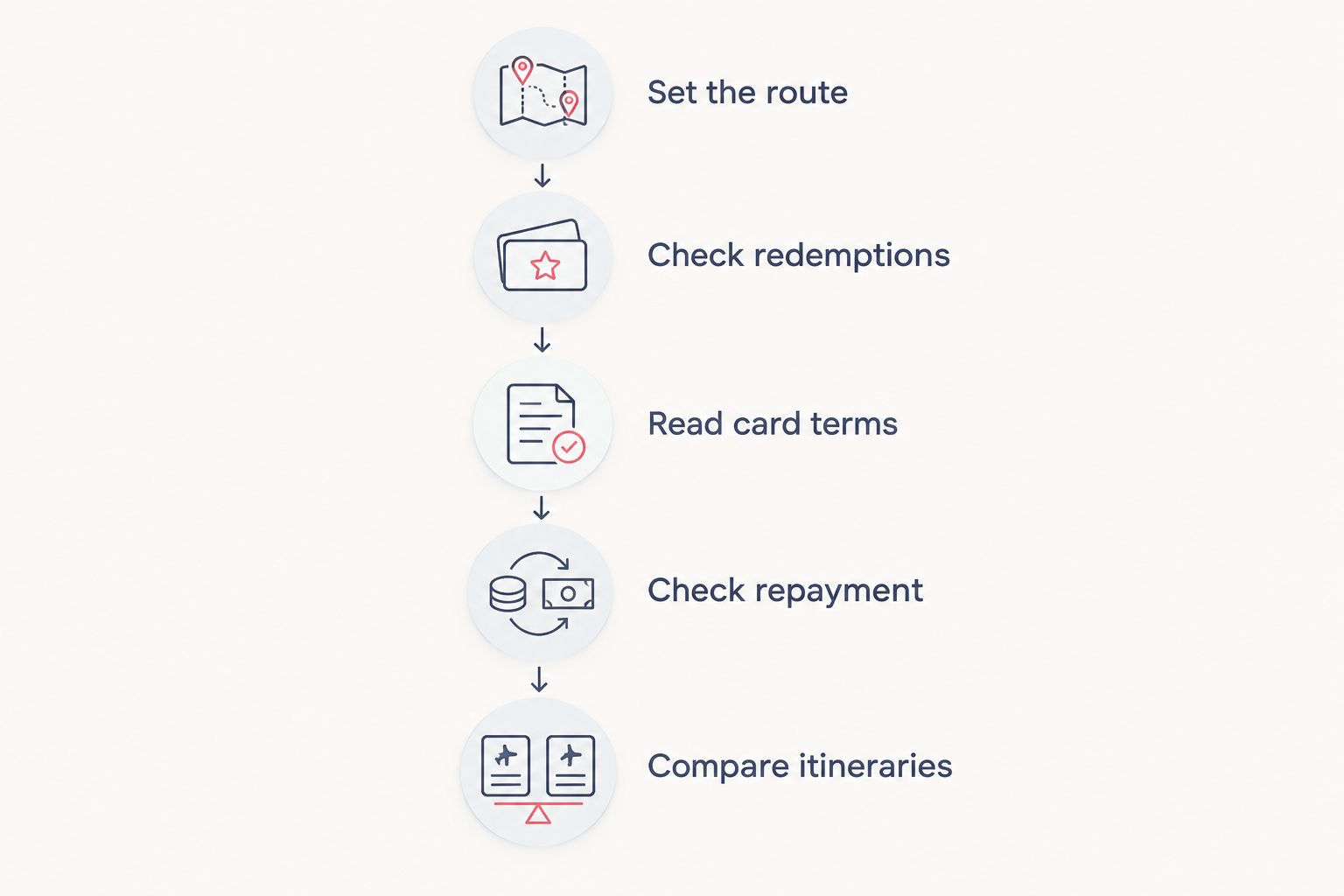
How to check whether points fit your India trip
Use this sequence before submitting a card application. It keeps the travel requirement ahead of the reward offer.
- Set the route. Write down your Australian departure airport, Indian destination, dates and passenger count. Search for 2 passengers if that is who will travel; a result for one person does not answer the same question.
- Check redemptions. Search the relevant loyalty programme for the journey, including connections and the return leg. Record any required cash component without assuming points cover everything.
- Read card terms. Confirm eligible spending, caps, transfer conditions, charges and bonus eligibility in the issuer’s current documents.
- Check repayment. Assess whether normal spending and your household budget support the account. Do not borrow more just to collect rewards.
- Compare itineraries. Compare the points booking with a paid ticket’s routing, baggage and change conditions before choosing.
The objective is a usable booking for 1 return trip, not the largest account balance. If the redemption does not fit, keep the flight decision separate from the card application.
For help comparing paid Australia-to-India itineraries, contact Mann Travel AU. Ask about your dates, destination and passenger needs rather than treating a points balance as the booking brief.
How we ranked these card structures
The ranking prioritises usable redemption options, existing balances, relevant transaction features and ongoing cost. Flexible points take the default position because the selection process starts without an established airline preference; an existing, useful loyalty balance changes that order.
This is not a product scorecard or an assessment of personal credit suitability. Current issuer documents establish card terms, and current loyalty-programme searches establish the redemption options you can assess.
Which credit card should you choose?
Start with flexible transferable points if you have no established programme preference. Start with your existing programme if you have a specific, suitable redemption target. Choose overseas-payment features for overseas spending, and lower ongoing fees when premium benefits do not fit your habits.
For a fixed-date 2026 trip, do not make your departure depend on a future bonus or an unconfirmed redemption. Secure a workable travel plan first. If repayments would stretch your budget, skip the rewards application rather than spending more to earn points.
FAQ
What are the best credit cards for flights to India from Australia?
The best structure is a transferable-points card with a useful redemption path, or a direct-earning card that builds an existing, usable airline balance. Compare current terms and your intended itinerary before selecting an individual card.
Is a Qantas Points card better than a Velocity Points card for India?
Neither is automatically better for India travel. Compare your existing balance and the reward bookings each programme offers for your departure city, destination, dates and passenger count.
Can I earn credit card points when booking through Mann Travel AU?
Eligible card purchases earn points according to your issuer’s terms. Check whether an agency payment qualifies for ordinary purchase rewards or any advertised airline-specific bonus category.
Should I transfer credit card points before finding a flight?
Check the redemption and transfer conditions before moving points. A transfer does not reserve a seat, and you should confirm processing and reversal rules before proceeding.
Does a points ticket cover every flight-related charge?
Do not assume a points ticket covers every charge. Review the redemption checkout, including any cash component and optional extras, before comparing it with a paid ticket.
Is credit card travel insurance enough for an India trip?
Included insurance is sufficient only if its eligibility, activation conditions and cover match your needs. Read the policy for traveller eligibility, trip duration, medical exclusions and excesses before relying on it.
Should I get a rewards card for a last-minute India flight?
Do not make a last-minute booking depend on a new card’s welcome points. Approval, qualifying spending, points crediting and redemption requirements are separate from securing your flight.
One last thing
Read the statement description, not just the airline logo. A flight bought through an agency is an agency transaction; do not assume it qualifies for a card benefit restricted to purchases made directly with an airline. Confirm the issuer’s wording before using that benefit to choose your payment method for a 2026 booking.
This article provides general information, not personal financial advice. Consider your circumstances and read the relevant card terms and insurance documents before applying.
Related guides
- Best airlines for baggage allowance on India flights
- Best airlines for families flying to India
- Best airlines for Melbourne to Amritsar flights

