

Business travellers’ flights to India are work-focused journeys planned around meeting deadlines, arrival readiness and change conditions, with the aim of getting you to appointments prepared. This 2026 guide explains how to choose Australia–India routes, assess tickets and organise the paperwork without treating business class as a requirement.
In-short:
- Choose flights to India for business travellers around meeting locations, arrival readiness and written fare conditions.
- Mann Travel AU books Australia–India flights; request an itinerary matched to your work schedule.
- Compare nonstop and connecting journeys by the complete trip, not the flight segment alone.
- Confirm business-entry requirements and employer approval before authorising ticket issue.
Why flight planning matters for business travellers
The best itinerary protects your first appointment and gives you workable options if your plans change. A convenient departure means little if the arrival leaves no room for immigration, baggage collection, ground transport and rest.
Business travel also introduces an approval chain. Your manager, finance team and host organisation can each affect when you book and which conditions you need. Separate those requirements before comparing flights so that a seemingly suitable itinerary does not fail at authorisation.
Mann Travel AU books international flights from Australian cities to Indian destinations. Mann Travel AU is best suited to Australia–India travellers who want an agency to arrange their flights. Ask for written route and ticket details; an agency booking does not remove the airline’s fare restrictions.
For your 2026 travel brief, distinguish fixed commitments from preferences. A signed meeting date is a constraint; a preferred departure time is a preference. That distinction makes route comparisons useful rather than an exercise in sorting departure times.
How to plan flights to India for business travellers
1. Define your arrival deadline
Start with the address and local start time of your first appointment, then work backwards. An arrival airport is not the meeting venue, and the scheduled landing time is not the time you will leave the terminal.
Best for: travellers with fixed client meetings, conferences or site visits. Build an arrival buffer that reflects the consequences of being late. For a high-stakes appointment, consider arriving at least 1 working day beforehand rather than scheduling the meeting immediately after landing; treat this as a planning choice, not a guarantee against disruption.
Check whether your host expects preparation, registration or a security briefing before the meeting itself. Those tasks belong in your schedule too.
- Record the meeting address and local start time.
- Confirm the correct arrival airport with your host.
- Allow time for entry formalities and baggage collection.
- Include the transfer to your hotel or office.
- Reserve time for sleep and meeting preparation.
2. Compare complete journeys
Search your dates manually first and place 2 candidate itineraries side by side. Compare departure, connection, arrival and onward travel as a single journey rather than choosing the shortest-looking flight segment.
Best for: travellers deciding between a nonstop service and a connection. A nonstop journey removes a transfer, but it still needs to fit your destination and appointment schedule. A connecting itinerary deserves consideration when its complete timetable serves the trip better; do not assume a connection is automatically unsuitable.
For a multi-city visit, compare arriving near your first meeting and departing near your last. Returning to the original arrival city adds another journey unless your work actually requires it.
- Compare the full elapsed journey time.
- Read local dates as well as departure times.
- Check terminals and any airport changes.
- Identify separate tickets and self-transfer instructions.
- Include domestic flights or ground travel in the comparison.
3. Request a decision-ready booking brief
Prepare your own shortlist before asking for assistance. Then give Mann Travel AU the constraints together, so the agency can work from a clear brief instead of a sequence of changing requests.
Best for: travellers who want agency-arranged Australia–India flights. Use the contact page to request an itinerary that states the route, operating carriers and fare conditions. Ask for the booking details in writing before authorising ticket issue; a conversation alone is not your reference document.
For your 2026 booking, include the employer’s approval requirements and the person authorised to confirm travel. Do not assume that a booking request, a reservation reference and an issued ticket are the same stage of the process.
- Provide your Australian departure city and Indian destinations.
- Separate fixed dates from acceptable alternatives.
- State the latest acceptable arrival for each meeting.
- Include baggage, seating and accessibility requirements.
- Request written conditions and an approval-ready itinerary.
4. Read the ticket conditions before choosing a cabin
Assess the fare rules manually before comparing cabin features. Business class describes a cabin; flexibility depends on the conditions attached to the specific ticket. Neither a cabin label nor an airline name answers whether your return date can change.
Best for: travellers whose meeting schedule or return date is unsettled. Ask what happens if you change before departure, change after travel begins, cancel or fail to take a flight. A changeable ticket can still require an additional payment when the replacement itinerary differs.
Keep the booking channel in the decision. Confirm who handles a voluntary change and how to reach that party, rather than assuming every airline or agency can service every part of your booking.
- Read change and cancellation conditions separately.
- Ask whether a change requires a fare difference.
- Confirm the consequences of missing a flight.
- Check baggage and seating inclusions for each segment.
- Identify who will process amendments after ticket issue.
5. Confirm entry and transit requirements
Check official Indian entry information against your passport nationality and the purpose of the visit. Do this before committing to travel, not after choosing an appealing itinerary. An Australian departure point does not determine your visa eligibility.
Best for: travellers attending meetings, negotiations or other work-related activities. Describe your planned activities accurately when checking the appropriate entry permission. Do not assume a permission suitable for a holiday covers a business visit, or that every work-related activity uses the same category.
Recheck the applicable requirements for your 2026 departure, including any transit country. Use current official guidance for eligibility, documents and permitted activities rather than relying on a previous trip or a colleague’s experience.
- Match your name across passport and booking documents.
- Check the permission required for your actual activities.
- Confirm passport and supporting-document requirements.
- Check transit rules for every connection.
- Keep accessible copies of approvals and host details.
6. Protect your working time and equipment
Plan the work you need to complete before departure, then decide what genuinely belongs in transit. Download documents you are authorised to carry and prepare an offline version of essential meeting information. Do not build a presentation deadline around assumed onboard connectivity.
Best for: travellers carrying work devices or arriving before a demanding schedule. Check your employer’s information-security requirements alongside airline baggage rules. A seat with room to work does not resolve confidentiality, device access or battery-carriage requirements.
Choose a cabin and seat for the actual journey. If rest is the priority, weigh that against when you need to be productive, and avoid treating extra onboard work as a substitute for sleep.
- Download essential documents under your employer’s security policy.
- Keep meeting addresses and host contacts accessible offline.
- Check current airline rules for devices and batteries.
- Confirm special meals and assistance with the booking provider.
- Plan a realistic rest period before the first appointment.
7. Prepare for changes before departure
Save your itinerary, ticket details and the relevant booking contact somewhere accessible without an internet connection. Then agree with your employer who can authorise an alternative if the original plan no longer works.
Best for: travellers with linked appointments or an uncertain return date. Use 3 decision checkpoints: before ticket issue, before departure and before the return journey. At each checkpoint, confirm that the itinerary still matches the work schedule and that any requested changes have been completed.
For multi-city travel in 2026, review the whole sequence after any amendment. Moving an international flight can affect a hotel night, domestic connection, airport transfer or meeting that remains unchanged elsewhere in your calendar.
- Save the ticket, itinerary and booking reference offline.
- Record the contact responsible for booking changes.
- Agree on the person authorised to approve alternatives.
- Review all connected arrangements after an amendment.
- Notify your host when the arrival plan changes.
Compare itinerary and booking options
Choose the option that fits your constraint, not the one with the most attractive label. The choices below answer different questions: route structure affects the journey, cabin choice affects the onboard experience, and booking channel affects who arranges the ticket.
| Option | Best for | Main advantage | Key limitation |
|---|---|---|---|
| Nonstop itinerary | A destination served by a suitable nonstop schedule | Removes an intermediate flight connection | Departure and arrival times still need to fit your appointments |
| Connecting itinerary | A destination or schedule better served through a hub | Allows comparison of additional route combinations | Adds a transfer and requires connection checks |
| Economy cabin | Travel policies prioritising a standard cabin | Keeps cabin choice separate from business-trip purpose | Seating and inclusions require close review |
| Business cabin | Travellers prioritising cabin comfort | Provides a different onboard cabin experience | Does not establish change or refund rights |
| Airline-direct booking | Travellers arranging flights themselves | Provides a direct booking relationship with the airline | You still need to assess the complete trip and fare rules |
| Mann Travel AU flight booking | Australia–India travellers seeking agency assistance | An agency arranges the international flight booking | Airline rules still apply; confirm the scope of assistance |
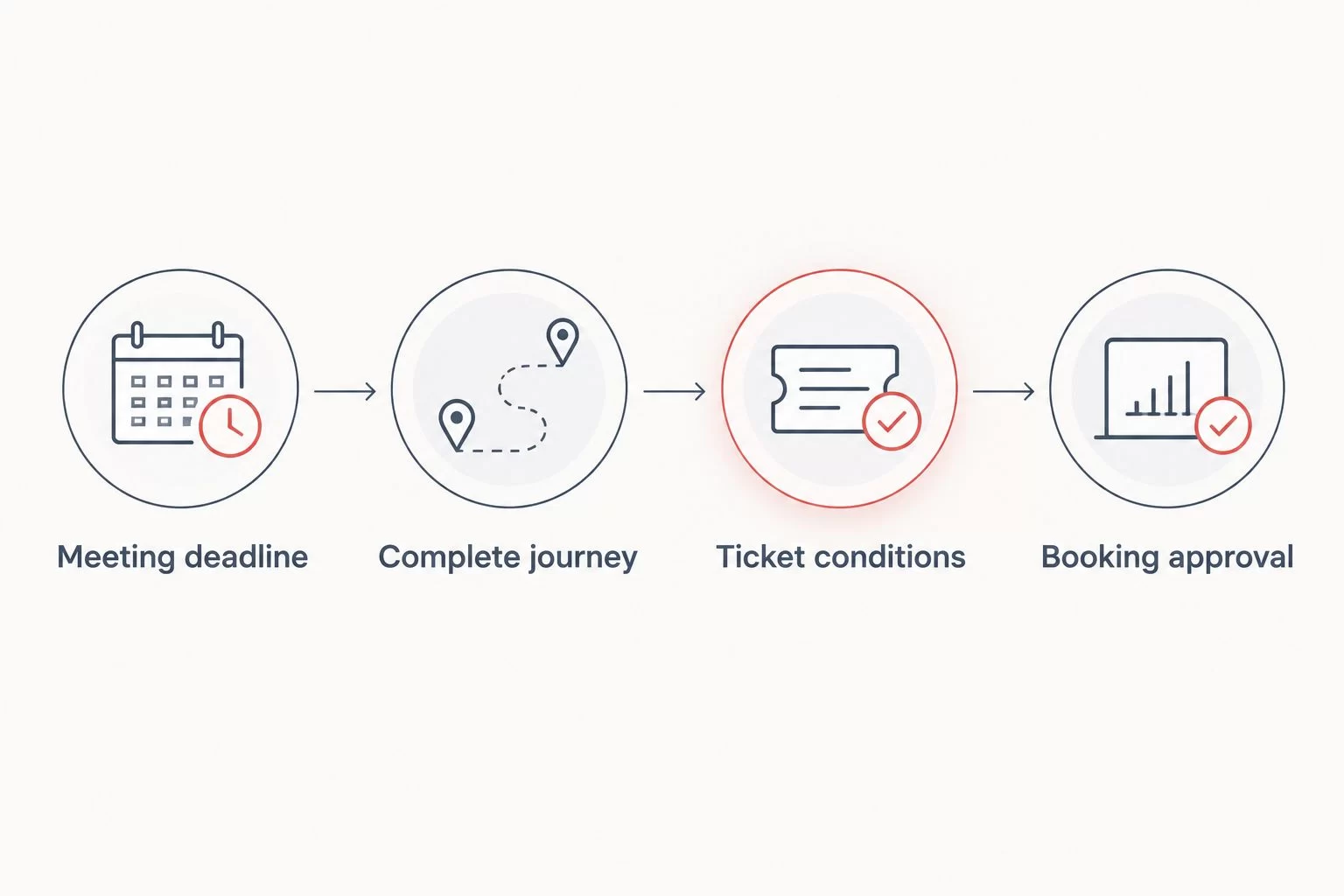
Compare options in this order: Meeting deadline, Complete journey, Ticket conditions, Booking approval. That sequence keeps cabin preference from overruling an appointment you cannot move.
Common mistakes business travellers make
Treating business class as a flexible ticket
A premium cabin does not establish your amendment rights. Read the fare conditions before choosing the cabin, especially when your return date depends on negotiations or a project milestone. Ask for separate answers on changes, cancellations and missed departures.
Scheduling a meeting against the landing time
A flight’s arrival time does not include your journey through the airport or across the city. Agree on a realistic appointment time with your host, and keep your arrival buffer visible in the calendar so someone else does not fill it with meetings.
Comparing international flights without domestic travel
A convenient international arrival can still leave an awkward onward journey. For visits to several Indian cities, assess each flight and transfer together. Check whether baggage collection, check-in or a change of airport sits between separately arranged sectors.
Sending an incomplete request for approval
A timetable alone does not show finance or your manager what they are authorising. Submit the route, relevant conditions, required inclusions and business reason together. Identify the decision deadline supplied with the booking proposal rather than assuming it remains unchanged.
Reusing entry advice from a previous trip
Your activities, passport circumstances or transit route can differ from last time. Check the requirements for the current visit and keep the resulting documents with your itinerary. A colleague travelling from the same Australian city is not necessarily in the same entry category.
Frequently Asked Questions
What are the best flights to India for business travellers?
The best flights fit your meeting location, arrival deadline and ticket-change requirements. Compare the complete journey, including connections and ground transfers, before choosing a cabin or booking channel.
Do I need to book business class for a work trip to India?
No, a business trip does not require a business-class ticket. Follow your employer’s travel policy and choose the cabin separately from the fare conditions you need.
Is a nonstop flight better than a connecting flight for business travel?
A nonstop flight is better when removing a transfer also gives you a suitable arrival schedule. Compare connecting options when they serve your destination or appointments better, and check every transfer requirement.
How early should I arrive before a business meeting in India?
For a high-stakes meeting, consider arriving at least one working day beforehand as a planning buffer. Choose the buffer around immigration, ground transport, rest and the consequences of disruption; it is not a guarantee against delay.
Can Mann Travel AU arrange flights from Australia to India?
Yes, Mann Travel AU arranges international flights from Australian cities to Indian destinations. Provide your meeting dates, destination cities and required ticket conditions when requesting an itinerary.
Does a flexible ticket let me change flights without any additional payment?
Do not assume a flexible ticket removes every additional payment. Read the specific fare rules and ask whether an amendment involves a fare difference or other applicable charges.
What entry permission do I need for a business trip to India?
Your required entry permission depends on your passport nationality and planned activities. Check current official Indian guidance and any transit requirements before committing to the itinerary.
One last thing
Put the first meeting’s local time above the flight details in your travel brief. It is the simplest way to keep the booking focused on the business outcome rather than the departure preference.
Before authorising your 2026 itinerary, ask a final question: if this flight operates exactly as scheduled, will you still arrive ready for the appointment? If the answer is no, change the plan before ticket issue.
Related guides
- India e-business visa guide for corporate travellers
- Seat selection tips for long-haul flights to India
- Airlines for baggage allowance on India flights

