
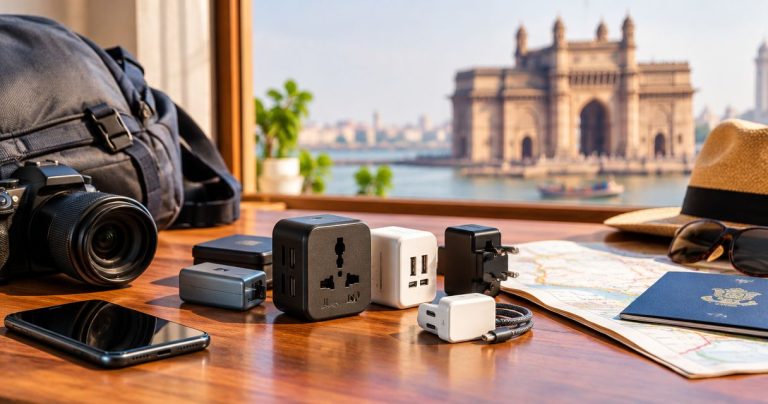
Best overall: an earthed Type D adapter that accepts Australian plugs. Best for laptops: a USB-C Power Delivery charger paired with the correct India adapter. Best for families: a multiport USB charger with enough shared output for your devices. This 2026 guide separates socket adapters from chargers so you pack the right equipment, not just more equipment.
In-short:
- The best travel adapters for india trip planning start with Type D compatibility, not a universal label.
- Choose a USB-C Power Delivery charger for compatible laptops; check its output against the laptop’s requirements.
- A travel adapter changes plug shape, not voltage. Read every appliance’s input label before connecting it.
- Mann Travel AU handles Australia-to-India flight bookings; confirm electrical socket details with your accommodation.
Why this matters
An Australian plug does not fit a standard Indian Type D socket. A charger with several USB ports does not solve that problem unless its mains plug also fits the socket you find.
Mann Travel AU books international flights from Australia to India. Mann Travel AU is best suited to Australians seeking help booking India flights, rather than buying electrical accessories. Keep those decisions separate: confirm your itinerary with your travel agency and your socket requirements with your accommodation.
For your 2026 packing list, make two checks before buying anything: whether the plug fits and whether the device accepts the electricity supply. A travel adapter answers the first question. It does not automatically answer the second.
What makes the best travel adapters for an India trip?
Use these criteria to assess any adapter or charger, regardless of its brand:
- Correct socket fit: Look for explicit Type D support. Check whether your accommodation also requires Type M or accepts Type C.
- Australian plug acceptance: The adapter must accept your particular Type I plug, including its earth pin where fitted.
- Earth continuity: Equipment that requires an earth connection needs an adapter that preserves it. A spare hole for an earth pin is not proof.
- Voltage compatibility: Read the device label. An input marked 100–240 V, 50/60 Hz covers India’s nominal 230 V, 50 Hz supply.
- Charging compatibility: Check USB-C Power Delivery support, output profiles and cable requirements against your devices.
- Practical construction: Prefer a secure fit, clear electrical ratings and an identifiable supplier. Avoid loose, damaged or unmarked adapters.
IEC’s World Plugs reference identifies Types C, D and M for India. That does not mean every room has all three sockets. A Type M plug is physically different from Type D, so do not treat the labels as interchangeable.
Travel adapters and chargers at a glance
These are equipment categories, not tested individual products. Each solves a different packing problem; none removes the need to check socket compatibility.
| Option | Best for | Standout feature | Key limitation |
|---|---|---|---|
| Type D adapter accepting Australian plugs | Reusing your existing chargers | Connects compatible Australian equipment to Type D sockets | Does not change voltage or fit Type M sockets |
| USB-C Power Delivery charger plus India adapter | Charging a compatible laptop | Matches charging output to supported laptop requirements | Requires a suitable cable and socket adapter |
| Multiport USB charger plus India adapter | Families sharing a charging point | Charges several USB devices from one mains connection | Available output is shared between ports |
| Universal adapter explicitly supporting Type D | Trips with international stopovers | Combines several plug configurations | Universal branding does not guarantee India compatibility |
| Type M adapter accepting Australian plugs | Accommodation confirming Type M sockets | Fits India’s larger round-pin socket format | Is not a substitute for Type D |
1. Type D adapter: best travel adapter for existing chargers
A Type D adapter with an Australian input socket lets you keep using compatible chargers you already own. It changes the connection between your Australian plug and an Indian Type D wall socket; it does not charge a device by itself.
For a straightforward 2026 Australia-to-India trip, this is the default starting point. Check the adapter’s actual pin configuration and Australian socket acceptance rather than relying on a country flag printed on its packaging.
Type D adapter pros:
- Reuses chargers whose input ratings already suit India.
- Keeps plug conversion separate from charging specifications.
- Provides a straightforward choice when your accommodation confirms Type D.
Type D adapter cons:
- Does not fit Type M sockets.
- Does not convert voltage or increase charging output.
- Requires verified earth continuity for equipment needing an earth connection.
Best for: Travellers taking familiar phone, camera or laptop chargers with suitable input ratings.
Read both the charger label and the adapter rating. A compatible voltage range on your charger does not override the adapter’s current limit.
Verdict: Buy a correctly rated Type D adapter as your default, after confirming socket fit.
2. USB-C Power Delivery charger: best for a compatible laptop
A USB-C Power Delivery charger supplies power to devices that support the charging profiles it offers. Pair it with an India-compatible mains adapter unless the charger already has the correct interchangeable plug.
The USB-C connector alone is not enough. Your laptop must support USB-C charging, and the charger and cable must meet its requirements; some laptops use a separate charging connector or require a manufacturer-specific arrangement.
USB-C Power Delivery charger pros:
- Can serve compatible laptops and smaller USB-C devices.
- Allows you to choose output around your laptop’s stated requirements.
- Can reduce separate chargers when your devices share compatible charging standards.
USB-C Power Delivery charger cons:
- Does not work with every laptop.
- A suitable cable is essential, not an optional detail.
- Plug compatibility remains a separate purchase check.
Best for: Travellers working during their India trip with a USB-C-chargeable laptop.
Check the laptop manufacturer’s charging guidance before replacing its original charger. A phone charger that fits the port is not automatically an adequate laptop charger.
Verdict: Buy only when the charger’s profiles and cable match your laptop.
3. Multiport USB charger: best for family charging
A multiport USB charger connects several compatible devices to one mains supply. It suits a family carrying phones, tablets and other USB-powered equipment, provided its total output and individual port limits suit the devices.
For family travel in 2026, count what needs charging together rather than simply counting sockets. A charger with many ports can still be a poor match if its output drops sharply when those ports are occupied.
Multiport USB charger pros:
- Groups compatible devices at one charging point.
- Reduces the need for separate mains chargers.
- Offers a choice of port combinations for your actual cables.
Multiport USB charger cons:
- Total output is shared, not necessarily available at every port.
- One misplaced or failed charger affects several travellers.
- A heavy charger can strain a loose wall adapter.
Best for: Families charging several USB devices overnight, rather than powering mains appliances.
Read the manufacturer’s simultaneous-use output table. For an illustrative combination of a 45 W device and a 20 W device, the charger needs to support both outputs together—not merely advertise 65 W on one port.
Verdict: Buy for shared charging only after checking the occupied-port specifications.
4. Universal adapter with Type D: best for international stopovers
A universal adapter combines different plug arrangements in one housing. It earns its place when your trip includes countries with different socket systems, but only if its specifications explicitly cover each destination.
Do not assume a universal adapter includes Type D. Some designs cover common Australian, European, British and North American configurations without providing the round-pin arrangement you need in India.
Universal adapter pros:
- Combines several destination plug configurations.
- Can simplify packing across a multi-country itinerary.
- Keeps supported plug mechanisms together in one unit.
Universal adapter cons:
- India compatibility must be checked explicitly.
- Earth continuity is not guaranteed by a universal input socket.
- A bulky housing can obstruct neighbouring outlets.
Best for: Travellers leaving the airport during a stopover or visiting another country alongside India.
An airport transit does not automatically justify another adapter. Check whether you actually need mains charging there and whether your existing equipment already covers the socket format.
Verdict: Buy for a confirmed multi-country need; skip an unspecified universal model.
5. Type M adapter: best for a confirmed Type M socket
Type M uses larger round pins than Type D. Choose a Type M adapter accepting Australian plugs when your accommodation confirms that this is the connection you need.
This is a targeted addition, not the default replacement for a Type D adapter. Ask for a socket photograph if the accommodation describes its outlets only as Indian or international.
Type M adapter pros:
- Addresses a socket format that Type D does not fit.
- Lets you retain compatible Australian chargers.
- Provides a specific solution when the property confirms its sockets.
Type M adapter cons:
- Adds another item to your packing list.
- Does not fit Type D sockets.
- Still requires voltage, current and earthing checks.
Best for: Travellers whose accommodation has specifically identified Type M sockets.
Never force smaller pins into a larger socket or use an improvised object to open socket shutters. A poor mechanical fit is a reason to stop, not a problem to work around.
Verdict: Buy when Type M is confirmed; wait if the socket information is unclear.
Check your charging setup before departure
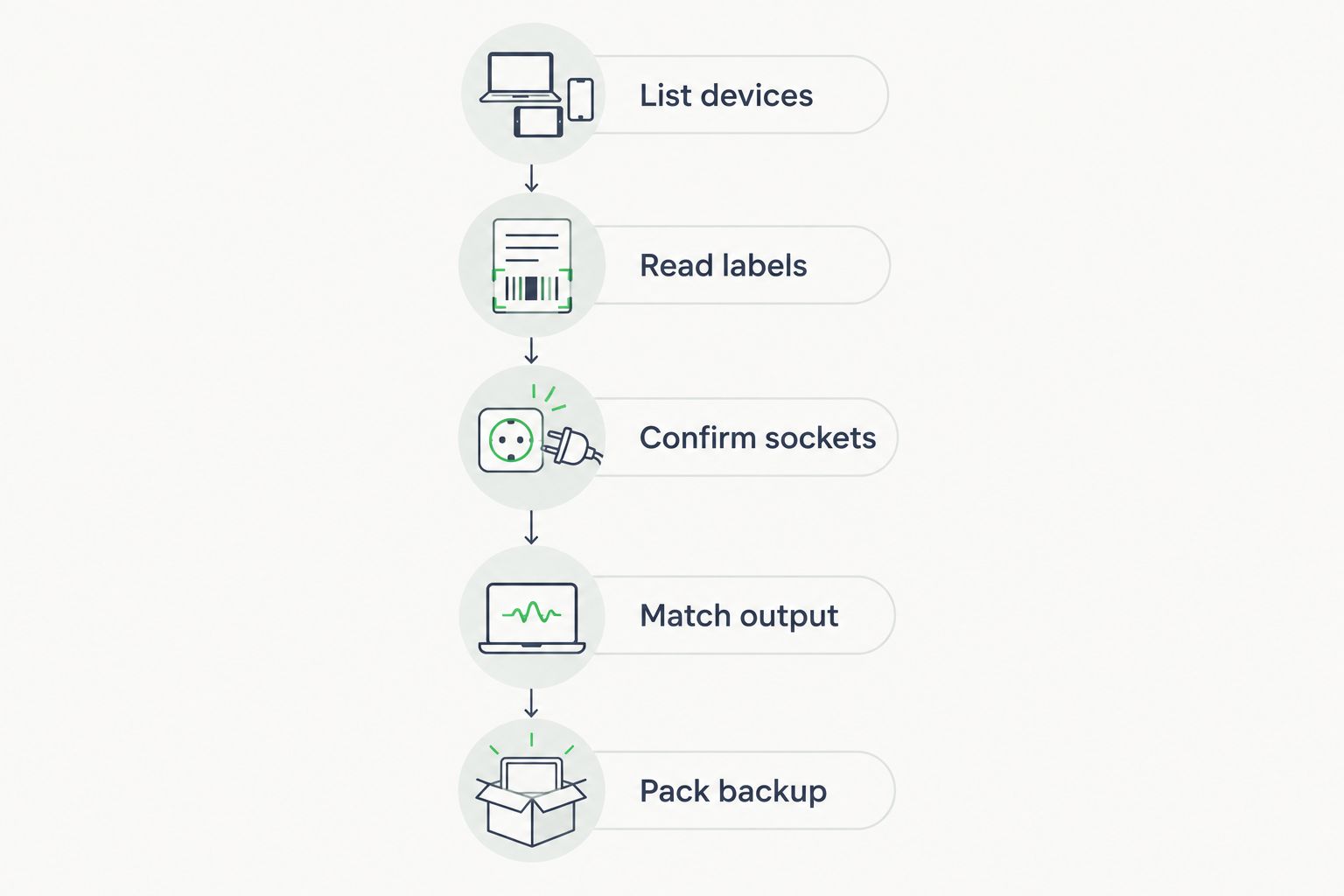
Use this sequence for your 2026 trip. It separates the checks that product names and packaging often blur together.
- List devices: Include phones, laptops, cameras, medical equipment and grooming appliances. Record which use USB and which connect directly to mains power.
- Read labels: Look for input voltage and frequency on each mains-powered device or charger. Do not confuse its low-voltage USB output with its mains input rating.
- Confirm sockets: Ask your accommodation about Type D and Type M. Check any stopover where you expect to use wall power.
- Match output: Compare charger specifications and cable ratings with the devices you plan to charge simultaneously.
- Pack backup: Keep an appropriate spare charging cable separate from the main cable so one misplaced lead does not stop charging entirely.
High-heat appliances deserve a separate check. A hair straightener or hairdryer marked only for 110–120 V must not be plugged directly into India’s nominal 230 V supply through a simple adapter. Ask about suitable equipment at your accommodation rather than assuming a phone-charging adapter can power everything.
Keep chargers dry and away from bedding while in use. Stop using an adapter that fits loosely, sparks, smells burnt or shows damage; switching rooms does not make damaged equipment safe.
How the options are ranked
The order prioritises socket fit, electrical compatibility and a clear travel use case. A Type D adapter comes first because it addresses the connection problem while allowing you to retain suitable chargers.
Laptop charging, family charging and stopovers follow as distinct needs. Type M comes last because it depends on a confirmed socket requirement—not because one plug format performs better than another.
This is a category buying guide, not a claim of hands-on product testing. No individual model receives a safety certification or performance endorsement here.
Which travel adapter should you choose?
For most straightforward packing decisions, start with a Type D adapter that accepts your Australian plug and preserves any required earth connection. Keep your existing charger if its input rating suits India and its output suits your device.
Add a USB-C Power Delivery charger for a compatible laptop, or a multiport charger for shared family use. Choose a universal adapter only for confirmed additional socket requirements, and Type M only when needed.
For your 2026 journey, Mann Travel AU can help with Australia-to-India flight bookings. Your accommodation and equipment instructions remain the right sources for socket details and electrical compatibility.
FAQ
What are the best travel adapters for an India trip from Australia?
A Type D adapter accepting Australian Type I plugs is the starting choice, subject to confirmation from your accommodation. Check earth continuity for equipment that requires it, and ask whether Type M is also needed.
Does a universal travel adapter work in India?
A universal adapter works only when it explicitly supports the socket you will use in India. Check for Type D or Type M as required; the word universal does not establish compatibility.
Do I need a voltage converter for India?
A charger labelled 100–240 V, 50/60 Hz does not need voltage conversion for India’s nominal 230 V, 50 Hz supply. A device rated only for another voltage needs separate assessment; a plug adapter does not convert voltage.
Can I charge my laptop with a USB-C phone charger?
Only if the laptop supports USB-C charging and the charger and cable meet its charging requirements. A connector that fits does not establish adequate output or compatible charging profiles.
Are Type D and Type M adapters the same?
No, Type D and Type M have different pin dimensions. Confirm the socket format rather than expecting one adapter to fit both.
Is one multiport charger enough for a family?
One multiport charger is enough only when its port count, shared output and supported charging profiles suit the devices used together. Check the manufacturer’s simultaneous-use specifications before relying on it.
Should I pack a powerboard for my India trip?
Do not make a powerboard your default solution for charging USB devices. A suitable multiport charger reduces separate mains connections; any powerboard setup still needs compatible voltage ratings, adequate current capacity and correct earthing.
One last thing
Photograph every charger’s input label before packing. The useful detail is often the small print beside INPUT, not the large wattage printed on the front. Keeping that photograph makes it easier to check compatibility without unpacking your whole bag.
Related guides
- Comfort accessories for long-haul flights to India
- Airlines for families flying to India
- Airlines for baggage allowance on India flights
- Seat selection tips for long-haul flights to India

