

Corporate travellers’ India e-business visa is an electronic visa for eligible business visits, with the aim of attending meetings and carrying out permitted commercial activities. This 2026 guide explains how Australian-based travellers can check eligibility, prepare business documents and coordinate flights without confusing a business visit with permission to work in India.
In-short:
- The India e-business visa for corporate travellers covers eligible business visits, not unrestricted employment in India.
- Check passport nationality, business purpose and entry conditions before submitting an India visa application.
- Mann Travel AU is best for Australian travellers seeking Australia-to-India flight bookings, not government visa decisions.
- Separate visa validity from permitted stay, and confirm approval before committing to restrictive travel arrangements.
Why business visa planning matters for corporate travellers
A corporate trip ties immigration requirements to commitments you cannot easily move: client meetings, supplier visits, trade events and internal approvals. A flight booking does not establish your right to enter India, and an invitation letter does not replace a visa.
For 2026 planning, keep three decisions separate: whether your activity qualifies, whether your passport is eligible and whether your itinerary meets the visa’s entry conditions. Australian residence alone does not answer any of these questions.
Flight conditions need their own review. The guide to baggage allowance on India flights helps you assess the flight side of a trip involving presentation equipment or additional luggage; visa approval remains a separate process.
Use the Government of India’s Indian Visa Online e-Visa guidance as the authority for eligibility, documents, validity and permitted entry points. Check the current instructions when applying, rather than relying on a saved checklist from an earlier trip.
How to organise your India e-business visa and flights
Check your passport and eligibility first
Start with the passport you will actually use, not your departure city or Australian residency status. Australian passport holders are eligible to apply for an Indian e-Visa, subject to the category’s conditions and the individual application assessment. Travellers holding another nationality must check that nationality’s eligibility separately.
Check that your passport has at least 6 months of validity remaining at your planned arrival and 2 blank pages for immigration stamps. Follow the application portal’s current passport-validity instructions as well. If renewal is needed, resolve it before linking an application and flight booking to the old passport.
Do not assume every colleague travelling from Melbourne or Sydney has the same entry requirements.
- Confirm the nationality and passport type used for travel.
- Check the official eligible-nationality list and any additional restrictions.
- Review passport expiry and blank pages.
- Resolve name differences across passport and company records.
- Check Australian re-entry requirements separately if you are not an Australian citizen.
Match the visa category to your actual work
Write a plain-language description of what you will do in India. Attending business meetings, discussing contracts and visiting suppliers are different from taking employment or performing an assignment that requires an employment visa. Your job title does not determine the correct category; your activities do.
The official e-business guidance lists permitted business purposes. Compare your itinerary with that list before choosing the category. Conference attendance also needs careful checking because India has a separate e-Conference category with its own conditions.
An invitation calling a trip a business visit does not settle the immigration classification. Ask your employer’s mobility or immigration adviser to resolve unclear activities before you submit the application.
- Describe each planned activity in ordinary language.
- Separate meetings from hands-on operational work.
- Identify whether a conference-specific category applies.
- Ask the Indian host to describe the visit accurately.
- Escalate employment or assignment questions before booking.
Build a flight plan without treating it as visa approval
Use a manual itinerary worksheet first. Record your Australian departure city, first Indian arrival airport, meeting city, onward transport and intended return date. This exposes a common planning problem: the airport used for immigration is not always the city where your meetings take place.
Mann Travel AU books international flights from Australia to India, giving you an agency-assisted alternative to assembling the flight booking yourself. The benefit is a separate booking contact for the journey; the limitation is that an agency cannot grant a visa or determine admission at the border.
For 2026 travel, confirm the booking’s change and cancellation conditions before committing. Mann Travel AU is best for Australian travellers seeking Australia-to-India flight bookings, not government visa decisions. You can discuss the flight component with Mann Travel AU.
- Identify the first Indian airport on the itinerary.
- Check that airport against permitted e-Visa entry points.
- Separate international and domestic connections in your plan.
- Read the actual fare’s change and cancellation conditions.
- Keep visa approval distinct from flight confirmation.
Prepare consistent business documents
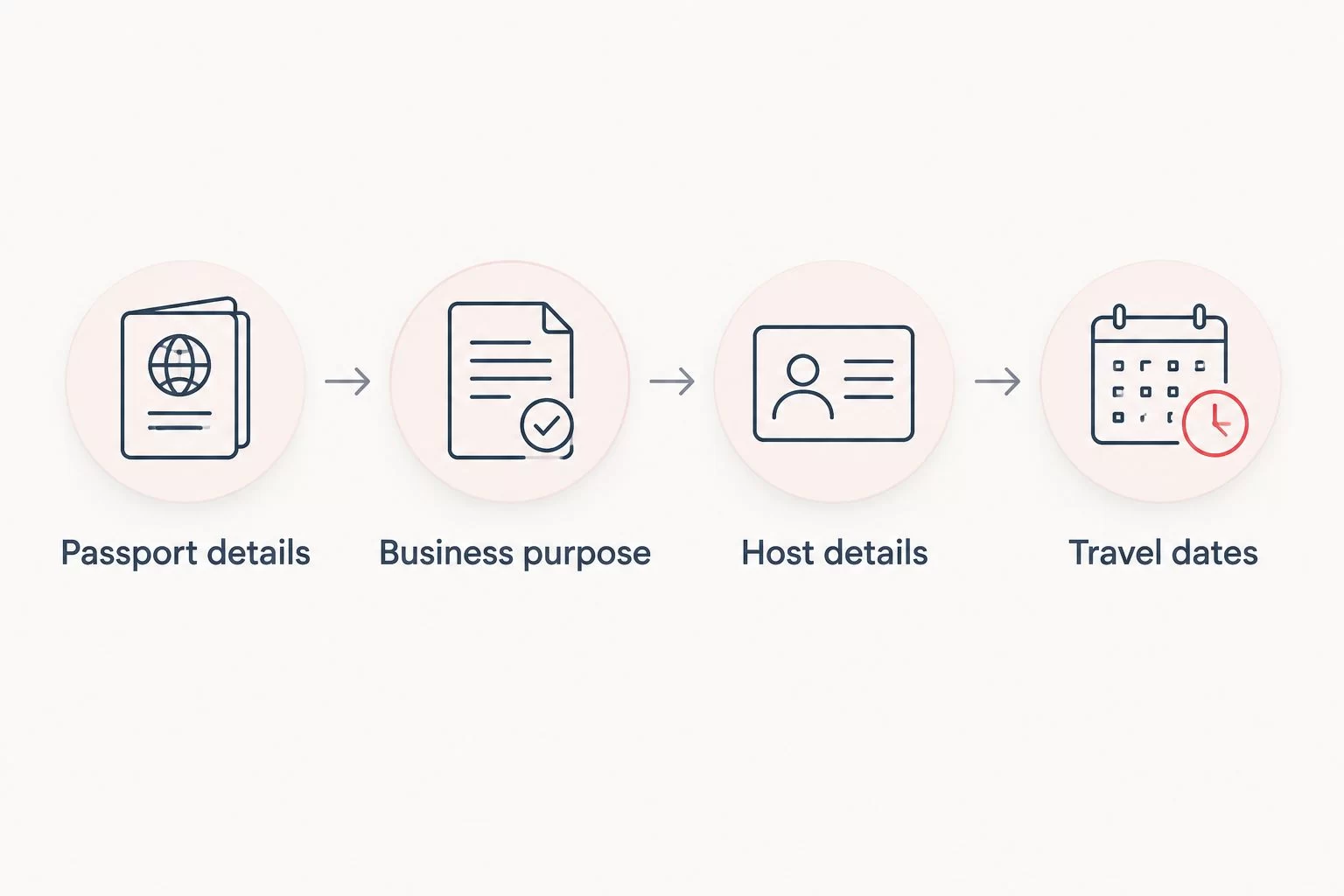
Create a single reference sheet before filling in the application. Use four headings: Passport details, Business purpose, Host details and Travel dates. Copy information from this sheet so the application, invitation and internal travel request do not contradict one another.
Indian e-business applications require supporting business information, including a business card and details relating to the Indian organisation associated with the visit. Follow the official document checklist for your selected purpose. An invitation letter is useful evidence of the visit, but it does not excuse incomplete application fields.
Ask your host to correct errors before submission. A clear document is more useful than a long letter full of vague corporate language.
- Passport details: match spelling, number and nationality exactly.
- Business purpose: describe the real activities and organisations involved.
- Host details: confirm the company name, address and contact person.
- Travel dates: align the visit window across supporting documents.
- Supporting files: follow the portal’s format and upload requirements.
Submit carefully and track the application
Apply through the Government of India’s official e-Visa portal and retain the application reference. Check the government identity of the service before entering passport details; a commercial application service is not the visa-issuing authority.
For your 2026 application, read the current submission window and processing instructions on the portal. Do not turn a stated processing timeframe into a guaranteed approval date. A submitted application, payment confirmation or saved draft is not the same as a granted Electronic Travel Authorisation, commonly called an ETA.
Review every field before submission, especially passport numbers and travel-document details. Keep the application accessible to the traveller rather than only in an administrator’s inbox.
- Confirm you are using the official government application service.
- Review names and passport numbers character by character.
- Save the application reference and submitted documents securely.
- Monitor the application status and relevant email account.
- Respond through the official process if further information is requested.
Read the approval before finalising the trip
India’s published e-business conditions state 365 days of validity from the grant of the ETA, with multiple entries, and a maximum continuous stay of 180 days. These are different limits: the validity period does not authorise a continuous stay for that entire period.
Read the actual approval and current government conditions before travel. Longer or repeated stays require particular attention to registration and other immigration obligations; refer those questions to the relevant Indian immigration authority rather than calculating permission from flight dates alone.
For 2026 bookings, compare the approved passport details and visa conditions with the final itinerary. If your passport changes after approval, check the official instructions before travelling.
- Confirm the approval is granted, not still under assessment.
- Check the passport number and personal details on the ETA.
- Distinguish the visa-validity period from the permitted stay.
- Check entry-point and registration conditions relevant to your trip.
- Carry the approval in the form required by official instructions.
Prepare the traveller and employer for departure
Keep a compact travel pack that you can access without relying on a single email account. Include your passport, granted ETA, business invitation or host details, itinerary and accommodation information. Store sensitive documents securely and share them only with people who need them.
Your employer should also know who handles a changed meeting date, disrupted connection or extended assignment. A flight change does not extend immigration permission. If your business purpose changes after approval, reassess the visa category rather than assuming the original permission covers the new task.
Finish the check before leaving for the airport, not during check-in.
- Carry the passport associated with the visa application.
- Keep the granted ETA accessible offline.
- Save the Indian host’s contact details.
- Confirm accommodation and onward travel arrangements.
- Agree on an escalation contact for itinerary or assignment changes.
Compare the visa pathways before choosing
These are immigration pathways, not interchangeable booking options. Choose according to eligibility and the actual activity; convenience comes second. The government or relevant Indian mission determines the application requirements.
| Option | Best for | Main advantage | Key limitation |
|---|---|---|---|
| e-Business visa | Eligible passport holders making permitted business visits | Online application route for qualifying activities | Restricted by nationality, purpose, entry conditions and stay limits; not unrestricted work permission |
| Regular business visa | Business travellers whose circumstances require the regular visa route | A separate application pathway when the e-Visa route does not fit | Requires the relevant mission’s process and supporting documents; approval is not automatic |
| Employment visa | Travellers undertaking employment that meets India’s employment-visa criteria | A category intended for qualifying employment rather than business visits | Has distinct eligibility and documentation requirements; a meeting invitation is not a substitute |
Self-application gives you direct control over the information submitted, but you remain responsible for accuracy and document preparation. Employer immigration support helps resolve category questions, while a flight-booking agency handles a different part of the journey. Do not substitute one role for another.
Common mistakes corporate travellers make
Treating Australian residency as visa eligibility
An Australian departure address does not make every passport eligible for an e-business visa. Check the traveller’s nationality and circumstances individually, particularly when an employer books several colleagues together.
Calling every overseas assignment a business visit
A short trip is not automatically a permitted business visit. Describe the actual duties, then match the visa category to those duties before the invitation and application are finalised.
Confusing validity with continuous stay
A multiple-entry visa does not remove the limit on each continuous stay. Read the granted conditions and track your dates independently of the company’s travel calendar.
Leaving the application entirely with an assistant
Administrative help does not remove the traveller’s need to check the submitted information. Review the passport details yourself and make sure you can access the granted ETA during travel.
Frequently Asked Questions
Can Australian citizens apply for an India e-business visa?
Australian passport holders are eligible to apply for an India e-business visa, subject to the category’s conditions and individual assessment. Australian residency alone does not establish eligibility for someone travelling on another nationality’s passport.
Can I work in India on an e-business visa?
An India e-business visa is not unrestricted permission to work in India. Compare your actual activities with the official permitted-business list and obtain category advice for employment or hands-on assignments.
How long is an Indian e-business visa valid?
India’s published e-business conditions state validity of 365 days from the grant of the ETA, with multiple entries. The maximum continuous stay is 180 days; read the granted conditions and check any registration obligations separately.
Do I need a letter from the Indian company?
Follow the official document checklist for your particular business purpose, including the required Indian business details and supporting evidence. A host invitation helps explain the visit but does not replace the application or guarantee approval.
Should I book flights before my e-business visa is approved?
Do not treat a flight booking as evidence of visa approval. Prepare the itinerary first, follow the application’s travel-information requirements and understand the fare conditions before making a restrictive commitment.
Can Mann Travel AU approve my India business visa?
No. Indian government authorities decide visa applications and admission. Mann Travel AU books Australia-to-India flights; keep the booking process separate from the government visa decision.
Can I enter India through any airport with an e-business visa?
No. e-Visa entry is restricted to designated entry points. Check the current official list against your first Indian arrival airport, including when a domestic connection takes you onwards to another city.
One last thing
Check the first Indian landing point, not just the destination printed on your meeting invitation. A journey to a regional office can involve immigration at a different airport, so that first arrival must match the e-Visa entry rules.
Once the visa pathway and travel dates are clear, contact Mann Travel AU to discuss the Australia-to-India flight booking. Keep the granted visa, passport and final itinerary together for your departure check.
Related guides

