
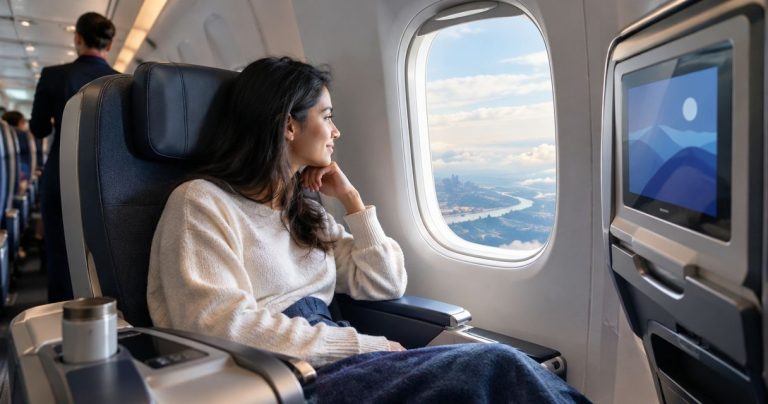
Best overall: a standard aisle seat away from toilets and galleys. Best for sleep: a window seat; best for eligible travellers needing more knee space: an extra-legroom seat. For Australians booking India flights through Mann Travel AU, the best seat selection for long haul flights to India starts with your main priority, then the aircraft’s actual seat map.
In-short:
- The best seat selection for long haul flights to India is an aisle seat when easy movement matters most.
- Choose a window seat for sleep without seatmates asking you to move.
- Check extra-legroom seats for eligibility, fixed armrests and storage restrictions before selecting.
- Mann Travel AU is best for Australians booking international flights to India.
Why this matters
A seat that suits a solo sleeper can frustrate someone who needs frequent toilet access. Families have another priority: sitting together without relying on another passenger to swap.
For your 2026 journey, select seats for each flight segment separately. A suitable seat on the Australia departure does not settle your onward connection, and matching seat numbers do not guarantee matching layouts.
Choose the seat’s function before its row number. These recommendations rank practical uses, not airlines or cabin classes.
What makes the best long-haul seat?
Use these criteria before choosing a seat on an Australia-to-India itinerary:
- Access: Can you leave your seat without asking someone to stand?
- Sleep: Will passing passengers, seatmates or nearby activity interrupt you?
- Usable space: Check knee room, armrests, under-seat storage and tray-table placement separately.
- Location: Look for toilets, galleys, bassinets, exits and cabin dividers on the map.
- Eligibility: Confirm restrictions for exit-row seating and any passenger assistance requirements.
- Group needs: Keep children, accompanying adults and travellers needing help appropriately seated together.
Extra legroom is not the same as extra seat width. A seat with a fixed armrest can feel more restrictive even when there is more space ahead.
Best seat options at a glance
These options overlap: a window seat can also sit over the wing. Start with your most important need, then use location to refine your choice.
| Rank and option | Best for | Main advantage | Key limitation |
|---|---|---|---|
| 1. Standard aisle seat | Independent movement | Leave without crossing seatmates | Passing traffic and seatmate interruptions |
| 2. Window seat | Sleep | No passenger needs to cross you | Restricted access to the aisle |
| 3. Seat near the wings | Reducing the sensation of pitching | Closer to the aircraft’s centre of rotation | No guarantee against turbulence |
| 4. Extra-legroom seat | More knee space | Greater clearance ahead where specified | Eligibility and fittings vary |
| 5. Confirmed bassinet-position bulkhead | Travelling with an eligible infant | Access to a designated bassinet position | Request and infant eligibility need confirmation |
| 6. Forward-cabin seat | Earlier exit through a front door | Fewer rows ahead when leaving | Does not guarantee a connection |
1. Standard aisle seat: best for independent movement
A standard aisle seat is the default choice if you want to stand, stretch or visit the toilet without crossing another passenger. Pick a position away from toilet entrances and galley work areas where the seat map permits.
You trade control over your own movement for interruptions from seatmates. Passing people and service trolleys also use the space immediately beside you.
Standard aisle seat pros:
- Direct access to the aisle.
- No need to wake a seatmate before getting up.
- Convenient access for a traveller who needs assistance from an accompanying adult nearby.
Standard aisle seat cons:
- Window or middle-seat passengers need you to move.
- Passing traffic can interrupt rest.
Best for: Travellers who prioritise movement over uninterrupted sleep.
Verdict: Buy this seat type when easy access is your main requirement.
2. Window seat: best for uninterrupted sleep
A window seat removes one common disturbance: another passenger asking you to stand. It also gives you control of the window shade where an individual shade is fitted, subject to crew instructions.
The disadvantage arrives when you need to get out. If your seatmates are asleep, reaching the aisle means waking them or waiting.
Window seat pros:
- Nobody needs to cross your seat to leave the row.
- Separation from passing aisle traffic.
- An outside view when conditions and the aircraft layout allow it.
Window seat cons:
- Getting up requires cooperation from seatmates.
- The cabin wall can restrict shoulder space at some positions.
Best for: Solo travellers who expect to sleep and rarely need aisle access.
Verdict: Buy a window seat for sleep; skip it if getting up easily matters more.
3. Seat near the wings: best for reducing pitching sensation
A seat near the aircraft’s centre of rotation experiences less movement from pitching than a seat farther from that point. The wing area is a useful starting point when you want to avoid the more pronounced movement felt towards the ends of the cabin.
This is not a turbulence-free zone. Aircraft type, weather and the nature of the movement still matter, so do not treat an overwing seat as protection from an uncomfortable flight.
Wing-area seat pros:
- A practical location preference for travellers sensitive to pitching.
- Often compatible with either an aisle or window preference.
- Lets you prioritise cabin position without choosing an exit row.
Wing-area seat cons:
- The wing can obstruct the view outside.
- Location does not remove turbulence or motion sickness.
Best for: Travellers who notice aircraft movement and want location to guide their selection.
Verdict: Buy a wing-area seat for location, not a promise of smooth air.
4. Extra-legroom seat: best for more knee space
An extra-legroom label describes space ahead, not every aspect of comfort. Check whether the seat is at an exit, behind a divider or in another specially spaced row before selecting it for your 2026 trip.
Exit-row passengers must meet the operating airline’s requirements and be willing and able to assist in an emergency. Fixed armrests, stored screens and restrictions on bags during take-off and landing can also change how the seat works.
Extra-legroom seat pros:
- More knee clearance where the aircraft’s seating information specifies it.
- Useful for travellers who find standard row spacing restrictive.
- A targeted alternative to changing the whole cabin class.
Extra-legroom seat cons:
- Exit-row restrictions exclude some travellers.
- Extra space ahead does not guarantee extra width or normal recline.
Best for: Eligible travellers whose main concern is knee room.
Verdict: Buy only after checking the exact seat’s restrictions and fittings.
5. Bassinet-position bulkhead: best for eligible infants
A bulkhead seat sits behind a partition rather than another passenger row. Some bulkheads have designated bassinet positions, but a bulkhead label alone does not establish that a bassinet can be used there.
Confirm the operating airline’s infant limits, the bassinet request and the accompanying adult’s seat assignment. A request is not the same as a confirmed arrangement, and crew instructions govern bassinet use onboard.
Bassinet-position bulkhead pros:
- Places the accompanying adult beside the designated bassinet position.
- No passenger seat immediately ahead of the bulkhead.
- Supports a seating plan built around an infant’s needs.
Bassinet-position bulkhead cons:
- Infant eligibility and the requested arrangement need confirmation.
- Under-seat storage and tray-table arrangements differ from standard rows.
Best for: Families whose infant meets the airline’s bassinet requirements.
Verdict: Hold until the airline confirms the bassinet arrangements and seating.
6. Forward-cabin seat: best for earlier disembarkation
A seat near the front of your cabin reduces the number of rows ahead when passengers leave through a front door. That makes it a useful preference when you want to leave promptly after landing.
It does not shorten immigration queues or change baggage delivery. Aircraft exit arrangements and airport procedures also affect how quickly you reach the terminal.
Forward-cabin seat pros:
- Fewer rows ahead when using a front exit.
- Useful for travellers who prefer not to wait through the full cabin’s exit.
- Can be combined with aisle seating for easier row access.
Forward-cabin seat cons:
- Nearby galleys or bassinets can affect the experience.
- Seat position cannot rescue an unsuitable connection.
Best for: Travellers who prioritise leaving the aircraft promptly.
Verdict: Buy for convenience; skip it as a solution to a tight connection.
Check the seat map before you commit
For 2026 bookings, use the operating airline’s map for the actual flight segment. A booking reference covering several flights does not mean every aircraft has the same cabin layout.
Follow this sequence before making your selection:
- Flight segment: Match the departure city, destination and operating airline.
- Cabin layout: Locate aisles, exits, toilets, galleys and partitions.
- Seat details: Check recline, armrests, storage and any eligibility notes.
- Group seating: Confirm each traveller’s position, not just the lead passenger’s.
- Final check: Recheck after an aircraft change and before departure.
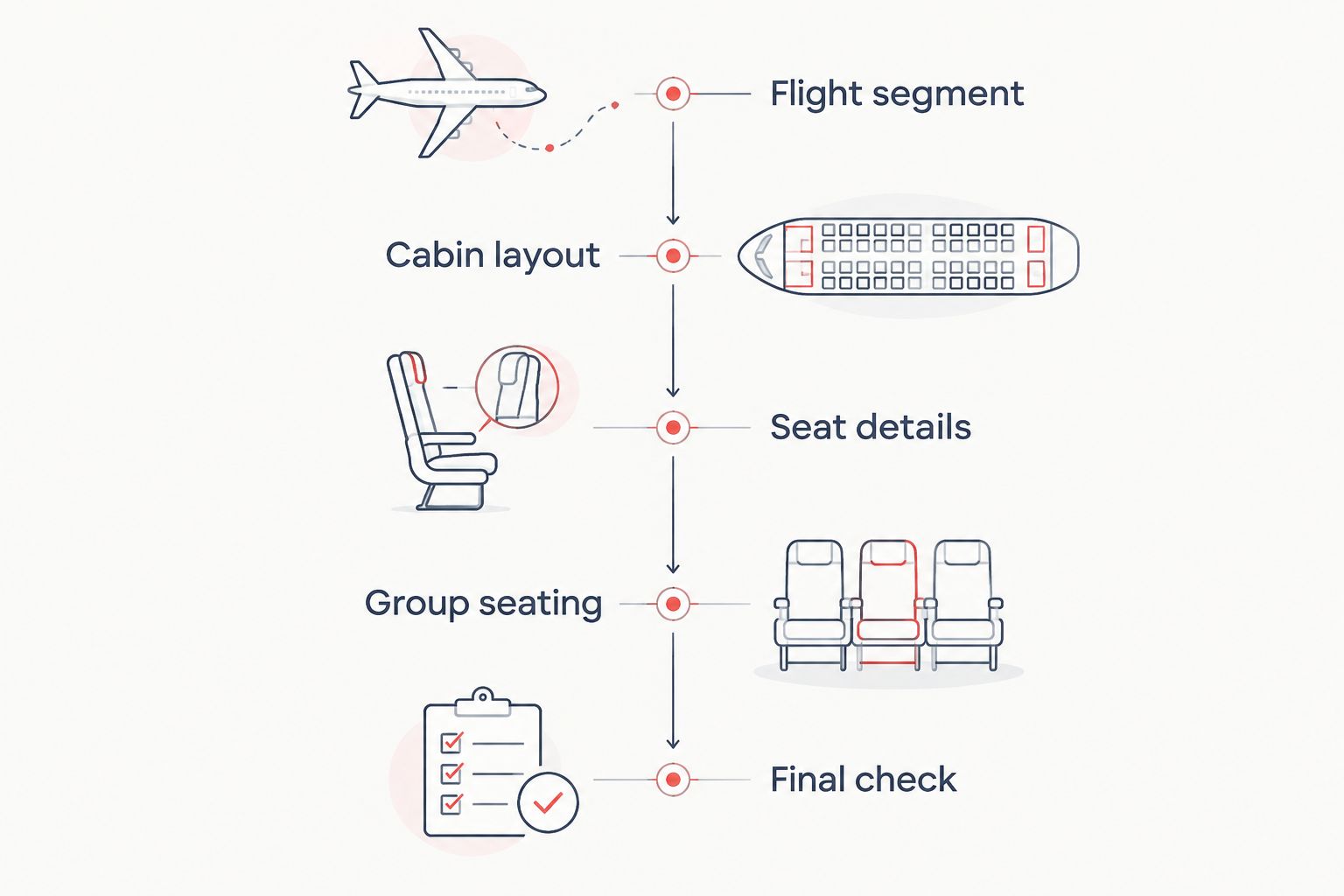
Layout matters more than a familiar seat letter. In a 2-4-2 layout, each outer pair has 2 seats; in a 3-3-3 layout, each outer block has 3 seats. A window passenger therefore crosses different numbers of seatmates depending on the configuration.
Do not assume that the same letter identifies the same position on every aircraft. Read the diagram, then check the selected seat’s description.
How the seat options are ranked
The ranking puts everyday usability first: aisle access, sleep, movement sensitivity, knee room, infant arrangements and exit convenience. It does not assign comfort scores or assume that one row works across every aircraft.
Mann Travel AU’s seat-selection recommendation for Australia-to-India flights is to match your main need first, then inspect the individual seat. An aisle near a toilet is not equivalent to an aisle elsewhere, and an exit-row window combines different benefits and restrictions from a standard window.
Which seat should you choose?
Choose a standard aisle seat away from toilets and galleys if you are undecided. It gives you control over getting up without depending on sleeping seatmates.
Change that default for a clear reason. Pick a window for sleep, investigate extra legroom for knee clearance, or prioritise confirmed adjacent seating when travelling with children.
For a 2026 international booking, give Mann Travel AU your departure city, Indian destination and travelling party details. Keep the seat checklist alongside your itinerary so that seating decisions remain specific to each segment.
Discuss your India flight booking
Tell Mann Travel AU your Australian departure city, Indian destination and travel dates.
FAQ
What is the best seat selection for long haul flights to India?
A standard aisle seat away from toilets and galleys is the best default when independent movement matters most. Choose a window instead if avoiding seatmate interruptions is your main sleep priority.
Is a window seat better than an aisle seat for sleeping?
A window seat is better for avoiding interruptions from passengers leaving your row. An aisle is better if you need to get up without disturbing anyone, so choose according to your usual sleep and movement habits.
Are exit-row seats always more comfortable?
No, exit-row seats are not automatically more comfortable. Check eligibility, armrests, recline and storage restrictions as well as knee space before selecting the exact seat.
Where should I sit if I dislike turbulence?
Choose a seat near the wings if your priority is reducing the sensation of aircraft pitching. No cabin position eliminates turbulence, and a seat choice does not prevent motion sickness.
Should families choose bulkhead seats on flights to India?
Choose a bulkhead for an infant only after checking whether it has a suitable bassinet position and confirming the arrangement. For families without that requirement, adjacent seating and appropriate adult supervision matter more than the bulkhead label.
Does choosing a seat guarantee I will keep it?
No, a selected seat is not an unconditional guarantee of that exact position. Aircraft substitutions and operational requirements can lead to reassignment, so check your booking again before departure.
Will sitting at the front help me make a connection?
A forward seat can reduce the number of rows ahead when passengers exit through a front door, but it does not guarantee your connection. Choose an itinerary with suitable connection time rather than relying on a seat position.
One last thing
The seat beside you matters as much as the space ahead. Before confirming your 2026 seat, trace the route from every position in your row to the aisle: who must stand, who must wait, and where an accompanying adult sits.
That simple check exposes compromises a seat number cannot explain. Make it before selecting, not after boarding.
Related guides
- Best airlines for families flying to India
- Best airlines for Melbourne to Amritsar flights
- Best airlines for Sydney to Delhi flights

